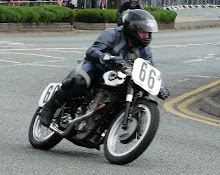
THIS MONTH'S FEATURE - THE SUPER FLASH STORY

THIS MONTH\
BSA Super Flash Dealer Photo

Tuesday, 10 February 2009

The BSA Super Flash Story

For one year only BSA made a super sports 650 pre-unit twin called the Super Flash.

It was conceived specifically for the US market and most of the 700 machines made went there. Little information was published about them in their short life and they are rarely mentioned in books about BSA history. Few have survived.


Why make a super sports twin? The Super Flash is the first example of a bike produced by BSA specifically for a particular market, in this case the USA. The requirements driving it's birth were simple - raw power.In early 1950's World War W II was five years distant, but many wartime restrictions remained.

In the monochrome austerity of continued rationing, fuel and housing shortages a motorcycle was for many people the only affordable means of transport. With manufacturing industry still picking it's way out of the ruins and crippled by US war debts, manufacturers were exhorted by their government to 'Export or die'. And the biggest market was the USA. Meanwhile in the US where the economy had largely recovered by 1946 and car ownership was widespread, motorcyles were for sports and leisure time. Consequently US buyers were more influenced by racing success than in the UK, and at that time this meant big Indian and Harley-Davidson(60 cubic inch V-twins.

By 1949, BSA had a US distributor and started making an impression on both leisure and sports riders. However, US AMA class 'C' restrictions meant that the OHV racing bikes bikes made by British manufacturers were limited to 500cc. Recognising the importance of the US market, BSA's chief designer Bert Hopwood went on a fact-finding mission in 1951 and met US dealers and riders. They made it very clear to him that if BSA wanted to increase it's sales presence it had to make bigger, faster bikes. On his return to the UK in 1951 the Super Flash was conceived.


What kind of bike? Bert Hopwood had certain constraints to work within. Since swinging arm frames and alloy heads were already in the planning stages a new model was out of the question. The bike would have to use as many existing parts as possible yet produce a bike that was much faster than the existing roadsters.
An impossible task? In fact BSA already had considerable experience. Veteran BSA competitor Fred Rist had been riding a tool room special 650 in sand races that could reach 140mph. A 650 ridden by Gene Thiessen had taken the AMA class 'B' record at 151mph at the Bonneville salt flats in October 1951. They had also been sending 500cc bikes to compete in the Daytona 200 that by 1953 could reach 130mph.

In the end there was no replacement for displacement so a 650cc or 40 cubic inch bike was made. The finished bike looked superficially like a plunger Gold Flash but with the obvious external differences kink in the seat post to accommodate the TT carb. Gold Star type chromed blade mudguards and stays were used. A 2.5 gallon tank Gold Star quick filler, chrome panels and metal tank badges was fitted with a unique 'Super Flash' decal on the tank top.
Inside however, the engine used many components that were not standard Gold Flash. In the press that accompanied it's launch these were described as 'special' though in reality their specification had probably been proven in the Rist, Thiessen and Daytona bikes.


The Super Flash had a brief life. First Super Flash is shipped in February 1953. In the same month American Motorcycling makes the bike 'Motor of the Month' with a 3 page review written by Roy Bradbury, general manager of the BSA's East coast distributor Rich Child Cycle co. This was reprinted later by BSA and used as a 4 page advertising brochure. In April 1953 the first bikes appear in US showrooms. In June 1953 BSA issues a list of parts to dealers as service bulletin no. 4F. In August 1953 the "You can buy 'em bigger" ad appear in US mags. The bike is priced at $975.00. In October 1953 a colour A3 foldout brochure is printed, probably in time for the Earls Court Motorcycle show in November. In November 1953 the Super Flash parts list appears as an appendix at the back of the 'A' models twin cylinder spares book. In the same month, the last Super Flash leaves BSA.

Initially, almost all Super Flashes were shipped to the US. But by the Autumn US shipments slowed down and machines began to be shipped to BSA dealers in Europe, Africa, Australia and the far east. Midway through 1953 BSA had already demonstrated a swing arm frame so most people knew it was on the way. Enthusiasts had also guessed that a new range of alloy head twins was being planned for 1954. With it's plunger frame and iron head the Super Flash would have seemed a dinosaur in comparison so potential buyers, unless desperate, would have waited for the new models. As US sales evaporated BSA tried harder to sell remaining Super Flashes any way they could.

Shipping records and anecdotes from owners suggests that the machine specification was changed either to use surplus parts or by customising to seal a deal. Things like changes in mudguard type, tank size, mudguard stays, handlebars and colours. The most significant change was to use a swing arm frame on some of the very last models shipped in late '53 and early '54. With this change and the appearance of the alloy head Road Rocket imminent, the game was pretty well up for the Super Flash. In a production life of about 1 year around 700 machines were built in all.

Why have so few survived? Of the 700 or so made, very few have survived. At a casual glance the Super Flash doesn't have much to distinguish it from any other old pre-unit BSA iron head twin. BSA pre-unit twins have never been considered glamorous and would have been treated accordingly when the mechanical 'end' came. Left for dead in garage corners, thrown in the river or a skip - many Super Flashes must have met the same fate. One of the reasons for appearing on this blog is to provide information that will help unearth bikes currently lying unidentified in workshop corners. It will also bring owners and information together to help get more bikes on the road.

If you wanted to create a classic motorcycling legend from scratch the sports specification, short production life and low survival rate could almost be used as a template. But the Super Flash isn't a legend because it is simply too obscure. It has managed to excuse itself from published BSA histories by being a US only model - most of the books are written in the UK, by UK historians about the bikes BSA made for the UK.

And the reason for its existence is much more mundane. Like the later Rocket Gold Star the Super Flash was a 'bitsa' put together using parts that were mostly already available in the product range or had been tried and tested in the competition shop.

It was a stop-gap machine made in sufficient numbers to qualify for US AMA class 'C' racing until Bert Hopwood's product rationalisation programme bore fruit with the swing-arm frame and A/B series gearbox in 1954. But what a stop-gap!

Monday, 9 February 2009

Roland Pike Autobiography - Chapter 30

Summary of development work

Rather than trying to visually compare inlet ports, we found it best to compare by measuring capacity with valve fitted in cc's using a burette, several engines that were down for power were found to be smaller capacity; 136cc instead of 148cc on an A7 twin, a B34 GS port 117cc extension 128 total induction 245cc.

All bench tests were carried out in uniform manner starting at lowest practical RPM and going up in increments of 250 RPM with no pause. Flash readings were never reported. We did try running power curves in reverse order starting at maximum revs and coming down but decided this gave false high readings.

Sandilands discovered almost by accident that a venturi shape after the carburettor can be 85% of the area of the carburettor body area with no loss of power, in fact it gave a small increase. We did most of our power curves with a flow meter hooked up between fuel tank and carburettor, this gives a valuable check on efficiency and also on correct carburettor settings.

When using two into one exhaust system it is desirable to have each pipe from the cylinder head to the junction of equal length if not carburation may be drastically affected at some point in the range. The way to avoid this problem is to ensure that each pipe has the same length to area ratio, in other words the longer piece will be larger diameter. In our experiments with the short stroke 500cc A7 twin we also found the angle of the two pipes at their intersection was important. I was at MIRA once waiting to use the timing strip whilst a group of Royal Enfield people tried to get the carburation right on one of the 700cc twins fitted with a two into one exhaust system, I noticed they were using the same diameter exhaust pipes of different lengths before the junction. Strangely enough this same rule holds good for induction pipes as found by Guzzi on their later single cylinder racers.

The A7 and A10 connecting rod bolts were originally BSF threads, we changed this to 26 threads per inch cycle threads as we thought larger area at the root of the thread would make a stronger bolt, we had to reduce torque when tightening the big end nuts proportionally, unfortunately someone in the drawing office forgot to tell the engine assembly and several bolts were broken before the error was discovered. Even more strange was the fact the broken bolts only happened to one of the several mechanics assembling the crank assemblies. I was asked to investigate, so sent Arthur Butler up to the engine assembly to watch how they did this torquing up. He returned a little later laughing with a small tobacco tin in his hand, It had plumbers tallow in it, apparently only one mechanic was putting tallow on the threads before tightening, with the results that nuts tightened appreciably more before the torque wrench recorded the correct torque figures. We accordingly tested some bolts with various lubricants on the thread and decided that important bolts such as connecting rod bolts should be assembled clean.

Oil Pumps.The BSA gear type pump is very simple and reliable, at one time we did some tests by simply running a pump on a drill press in a can of oil and measuring the temperature of the oil, we were surprised at how quickly the temperature rose especially as there was not resistance to the flow. On examination of the pump we decided that some oil was being compressed between the two gears, accordingly a small bypass was cut in the cover plate allowing oil to feed back to the inlet side of the pump. Further testing showed practically no heat build up in the oil. Some tests were carried out on A7 (using various viscosity oils, starting with 50 wt and coming down to 40 wt to 30 wt, 20 wt SAE 10 and finally 5 wt. We discovered that normal oil pressure was maintained on the SAE 10 50 wt, 40 wt and 30 wt. At SAE 20 viscosity pressure tended to drop particularly when hot. The engine was stripped at this point to see if the low pressure caused any bearing problems, everything looked pretty good. At SAE 10 wt pressure seemed very low in fact when hot was nil a further examination of the bearings and pistons showed no sign of trouble but the cam followers did not look too happy, starting to score.

A final run was made with SAE 5 wt pressure almost nil when cold, showed nil when hot especially when engine was revved up, finally the timing side main bearing failed. On stripping the engine we found the white metal had melted and run, but no trace of it in the oil or crankcase, when the sealing plugs were removed from the crankshaft the white metal, was found to be inside the oil passages of the crankshaft, the connecting rod bearings appeared to be in good condition. Apparently the light 5 wt oil was thrown outwards to the big end bearings by centrifugal force enough to lubricate the big end bearings adequately but in such quantity that it robbed oil from the main bearings faster than the oil pump could replace it.

One interesting test was when we set up a A10 engine and gearbox unit on the test bed driving the dyno by a short chain, the object was to try and measure the power loss in the gearbox in each gear. We could not measure the power in 1st gear as the dyno was turning too slowly to absorb the considerable torque due to the low gear ratio. As we expected the most efficient gear was 4th, the direct gear.

Surprisingly, 2nd gear was more efficient than 3rd gear due presumably to the fact that 2nd gear wheels were better supported than 3rd. The final part of the test was when we removed the gearbox and clutch and tried to run a fairly long chain from the engine to the dyno direct to see what difference was with gearbox out of action. To our surprise it could not be done, this rather long chain just whipped and banged and would not transmit power. We had to move the engine back on the block and used a short chain. Incidentally the power loss in 3rd gear was about 10% with about 8% loss in 2nd gear as compared with 4th gear with only 2%. One of the lesser known advantages of the eccentric rocker spindles is the ability to adjust the valves whilst the engine is running.

I suggested this to Reg Wilkes one day, however, he did not seem very keen to stand astride a high revving engine with a wrench in either hand so I appointed myself as the rocker manipulator. We started off on the 500 Gold Star race engine at about 5000 rpm with me firmly astride and adjusted each rocker until the maximum power reading was obtained. The engine was then blown cool with the fan and clearance checked, the inlet figure was something like .009" and exhaust a little more. Then the engine was run at 6000rpm and again rockers adjusted for maximum power and cooled down to room temperature and clearances checked, this time the inlet was .006" and exhaust .008".

Next a reading was taken at 6500 rpm and again clearances checked when cool. Now the inlet clearance was down to about .003" and exhaust .006", subsequent checks were made at 7000 rpm and 7500, with some pointed remarks made about what happened to me if the engine shuld blow up while I am astride it. The results at 7000 rpm were clearances Inlet .001" Exhaust .004" at 7500 rpm inlet nil, exhaust clearances .003". These were not exact figures (my memory is not that good) but the general trend was there at the higher revolutions the rockers and push rods were bending and whipping slightly.

Prior to these tests we had always set valve clearances with a cold engine, with inlet push rod just free to rotate and .003" clearance on the exhaust. The normal practice with regard to rocker angle in relation to valve stem has been to arrange for the rocker to be at right angles to the valve stem at half lift, the object being to minimise side thrust and cut down on valve guide wear. In the course of experiments with both the C12 and the A7 engine better running at high revolutions could be obtained when the rocker was at right angles to the valve stem at about l/32"to 1/16" lift. It was thought that this arrangement aligned the valve seat with the valve seat in the head just as the valve was closing, whereas with the common setting at half lift, the rocker side thrust will tip the valve slightly in the guide when seating and will have to realign itself as it seats. At very high revolutions there is not enough time for this and some efficiency will be lost. On the C12 this was visible even by turning the engine by hand, by inserting some packing between the rocker mounts and the head we were able to see the improved action. It is quite possible that most overhead valve engines using rockers could benefit from this rearrangement of rocker angles.

One unexpected results when trying a much larger and stiffer crankpin with plain bearing was considerable difficulty in lining up the flywheel assembly, presumably the wider shoulders made the assembly more rigid. Engine gaskets between rocker box and cylinder head usually made of paper were replaced with metal corrugated gaskets, these could be used over and over again and sealed better.

During the five years I was at BSA doing engine development I was fortunate in attracting some very bright and enthusiastic mechanics and apprentices, they all contributed to the progress we made with development of the BSA range. There was tendency to specialise but most could handle anything that came in the shop. Jimmy Gibbard did most of the odd machinery jobs, Jack Turner did the intricate inlet port arrangements and exploited the extra down draft angles and straight ports. Reg Wilkes, Bert Hole, Arthur Butler, Arthur Bridgewood, Bill Bently and Alan Sandilands could handle any aspect of engine building , the apprentices who spent more than average time with us were Gordon Smith, Robert Trigg, Ray Beech, David Harris and John Taft. Albert Dyde, ??? Harrison Ward and Hill came into the shop later. We also had some colonials like Barry Stormont and Cohn Mather during the winter months. I learned a great deal and was able to try out many ideas that I could never have done in the ordinary way, for this I am grateful to Mr Hopwood and BSA for this opportunity.

One of the chief abilities necessary in this type of work is to be able to 'sell' ideas to the Management, something I was not very good at. Thanks to BSA sending me to the USA on business trips I decided to emigrate and have had an interesting life in USA becoming a citizen in 1982, finally having my own business and a and a decent workshop including a dynomometer. I have not lost interest in motorcycles and at 75 own a 250cc Kawasaki 'Ninja', a remarkable little machine with a performance in road trim better than my old racers. We still enjoy trips to Road Atlanta to watch the motor cycle road each year.

Roland Pike Autobiography - Chapter 29

A continental tour on A10 combination

As a result of our trip to Monthlery in May of 1953 to test the various models, I was keen to spend a holiday in France to show my wife the city of Paris and the other places I had seen and was also very keen to visit Carcassone the famous walled city in the Pyrenees.

We left our small daughter with her grandparents who lived near Folkstone and took the ferry from Dover to Boulogne using our BSA A10 sidecar outfit as transportation. We reached Paris after a rough crossing of the channel in time to garage the combination and go for a sight seeing walk. We took in the Eiffel tower and the ornamental gardens then had a typical French meal in a nearby restaurant. We stayed the night at the Hotel Vermont where Charlie Salt and I had stayed whilst at Monthlery. Next day we left Paris for Orleans and the Loire valley seeing many of the lovely Chateaux, we particularly enjoyed the Chateaux at Blois which served as the inspiration for Biltmore House near Ashville, North Carolina. We finished up that day in a little market town and stayed in a small country inn. Ruth and I had hardly a dozen words of French between us but fortunately some other English tourists arrived and spoke fluently. The inn was quite comfortable and we enjoyed an excellent dinner with wine in the evening. I remember reeling away from the table and going for a walk round the town and discovered a rope walk along a stretch of grass beside a wall with windlasses at each end, it appeared to be still in use.

Next day we drove across the Landes, flat and sandy and thick with pine forests, there was evidence of various forest fires which does afflict that area. The road was narrow straight and flat and rather bumpy, as we approached Bordeaux we passed miles and miles of vineyards and many of the villages we passed bore the names of famous red wines. Going through the city I noticed we were being followed by two policemen on what appeared to be BMWs but in fact were Gnome et Rhones built under licence from BMW They followed us right through the town, perhaps waiting for me to exceed the speed limit or some traffic infraction, but they did not sto top us thankfully. The next town of any size was Biarritz, a famous gambling centre in Edwardian days, the road runs close to the sea all the way from there to the Spanish border.

We decided to stop near there at a little town called Jean de Luc, tile hotel appeared to be full up, it is a resort town but the proprietress who spoke excellent English said she could put us up in the annexe. This turned at to be a cottage owned by an employee and nothing seemed to work in it. Plumbing was a very smelly affair. We ate in the hotel proper and excellent food it was. The waitress detailed to attend to us spoke no English but we managed to order a meal and of course wine and as it turned out although we were not sure what we were eating at times it was all delicious. Next morning after a restless night we were glad to make an early start, we had come to the conclusion French breakfasts were a waste of time as it consisted of just croissants & coffee. We had already got into the habit of combining breakfast and lunch and buying food from local shops, which was much more filling and satisfactory. At one stop for petrol the old lady attendant asked if we would like a glass of wine, it was very hot driving, we agreed and she poured us almost a tumbler apiece of a sweet white wine that she had in a large chilled bottle, it was delicious and more thirst quenching that we thought it would be. We could not cross into Spain on this trip as we did not have the necessary visas. The road came right up alongside the border in places, there were no customs posts at all these border points and there were signs requesting you to report to the nearest Custom post within 24 hours.
That night we got as far as Oloro and stayed in one of the nicer hotels of the trip. The owner had travelled all over the world, there was a grand display of trophies in the main hallway. The daughter spoke excellent English and they looked after us very well. On the way that day we had passed through a town called Mauleon whose main industry was making string soled shoes called espadrilles. I remembered my father had brought us some when he came back from a trip in 1921, you could not wear the darn things out. We had an amusing highlight going along on the outfit, as it being rather a hot day I had discarded some of the heavy outer motor cycling clothes, Ruth was reclining behind the sidecar windscreen, when three French damsels on bicycles started waving to me, but as they drew abreast they spotted my wife and they were covered with confusion when they spotted her. Next day we went to Lourdes, where faith healing miracles are said to occur but it was kind of honky-tonk with all manner of picture postcard stands catering to the tourists.

We were glad to get away from there and climbed and climbed up the valley Catercaux where the famous waterfalls are, we finally came out in the clouds, it was misty and we were unable to take any pictures so fell back on buying postcards from a vender. There were wonderful fields full of wild flowers. The head of the valley was at about 7000 feet but unfortunately it did not go any further and we had to retrace our route down again. Next on our itinerary was the ??? of Foix with an old castle to which we had to pay admission, they charged us twice the amount that was quoted in a one year old guide book! We left there the next morning and travelled through a small town called Montreal where I photographed a man driving some huge oxen. From there we went on to Carcassone, this was the high spot of our tour, after parking the outfit outside the main gate we spent several hours walking around the battlements and exploring the ancient city it has been beautifully restored to its ancient style with narrow streets with shops and a hotel and church, the whole place is on a hill and from the battlements one has a fine view of the countryside and the old town down in the valley. Reluctantly we left the old city and crossed the last ridges of the Pyrenees to the Mediterranean coast near Perpignan. At one little resort near the Spanish border we parked the bike and looked over the rocky cliff edge and for my pleasure was a girl who was brown all over, I guess she thought it was safe to sun bathe in the nude thinking she could not be seen.

We retraced our way towards the east aiming to go along the coast and up the Rhone valley and got as far as the old Roman town of Montpelier. After dinner we went for a walk round the town which seemed to be a rather nice place with decent shops in fact quite a pleasant city. Next day we passed through another Roman town, Nimes. Here there is the remains of an amphitheatre similar to the one in Rome, slightly smaller. On leaving the town we passed an aqueduct built in Roman times, it was over 100 feet high in places and in remarkably good condition. Rather than go into the Carn??? we drove across the salt flats where they were scraping up, salt from evaporating sea water. We then turned inland and took a short cut to Avignon of bridge fame where we joined N5 a main road and rather boring until we came to Montellimar which exuded a delightful smell of nougat its main industry, there were shops along the road selling it in various flavours. Wanting to avoid going through Lyons with its heavy traffic we took a detour and came out north of the city and on to ??A10ns for the night to stay at a hotel aptly named Hotel du Commerce, it seemed to have trucks and trains passing by all night. Next day we passed Vermenton famous for its potteries and fine chinaware stopping in a new hotel in Joigny. From here it was not far to Paris which we passed quickly through in the afternoon, the traffic as usual was moving fast and we had to drive quite hard to keep up, we took the road north through Beauvais, here on the weather deteriorated and we had our first rain of the trip, we stayed at a typical tourist hotel with much coming and going. The next day was a very soggy ride to Boulogne and Calais where we caught the afternoon ferry to Dover. It was still light when we disembarked at Dover being summer time but at quite a late hour. The Customs officer was quite intrigued as we had so little to declare, he must have thought we were smuggling as he made a thorough search of all our baggage and the bike, but our main was soiled clothing.

We collected our daughter next day and returned to ???. I had totalled 2300 miles in the ten days, the outfit was still running well except for a slight bearing rumble and a tendency to transfer oil from the chain case to the engine. We had had to stop several times on the trip to refill the chain case. It was easy to tell when the oil was low in the chain case as the whole machine felt rough. I am sure if I had not kept filling the case the chain would have overheated and broken. I reported this to Mr Hopwood who suggested stripping the engine and trying to find out the reason for the transfer of oil, as he had had complaints of this nature from the US.

The bearing rumble turned out to be the timing side main bearing white metal flaking away. This was a common problem. This time it inspired me to investigate the whole bearing problem, trying out needle bearings, bushes and improved white metal bearings. After re-assembly we set the outfit up with manometers connected to the rocker box and the chain case filler cap and the timing case. These water manometers were quite simply two glass tubes connected at the bottom by a rubber hose and partially filled with water, one tube was left open to the atmosphere at the Back to top whilst the other end was hooked up to the chain case or crankcase etc. The difference in pressure pushes the water up on one side and down the other. The height of one side above or below the other pressure in inches of water, for bigger pressure differences mercury would be used instead of water, flue to the mechanical breather valve the pressure in the crankcase at touring speed is about 4"- 7gi of water below, atmosphere, the crankshaft seal was the single lip variety designed to keep oil from passing OUT of the crankcase. So of course it did nothing to prevent chain case oil being pushed into the engine by atmospheric pressure, a change to a double lipped seal cured the problem.