Sunday, 19 December 2010

Kenny Eggers - as one door closes...

This blog arrives at the beginning of 2011 to tell you about something that happened at the very beginning of 2010 - the death of Kenny Eggers.


Kenny seated on the restored Daytona BSA A7 in 2004

It also marks the return of the Beezagent to active BSA blogging after a very difficult and distracting year.

In January this year Kenny Eggers, one of the BSA 'wrecking crew' that took the first 5 places at Daytona in 1954 died after a short illness.

Kenny started his riding career in 1941 at the age of 12 riding a 1929 JD 74 ci Harley. Racing leathers were temporarily put aside when he joined the army but dusted-off again when he returned to civilian life in 1948 and started riding for the famous tuner Tom Sifton, then a Harley dealer in San Jose, California.

Kenny quickly became one of the fast guys to watch on the West coast and in 1952 wanted to ride at Daytona but Harley wouldn’t give him a bike – they reckoned he was too small to hang-on to a bike for the full 200 miles of Daytona. In stepped West coast BSA Distributor Hap Alzina, who had kept an eye on Kenny after his performance at Belmont, a track south of San Francisco and gave him a BSA Star Twin on which he came tenth.

There followed a brief spell on a Triumph though Phil Cancilla but after a recommendation from West coast BSA regular Gene Thiessen he returned to BSA and Hap Alzina again in 1953 to become one of the famous BSA Wrecking Crew that was so successful at Daytona in 1954.

Riding a rigid BSA Shooting Star, Kenny came fifth and just a month after Daytona, the same bike fitted with high bars was used to win the 125 Mile National road race at Willow Springs California in April 1954 then win again later in the year at the Portland Mile in Oregon.

Kenny retired from racing in 1957 but didn’t retire from bikes which he rode and restored and I first contacted Kenny then met him as part of the Project Daytona 50th Anniversary Celebrations in 2004. I only met Kenny during the 50th Anniversary Daytona events that was involved in but he made a big and memorable impression.

At Daytona in 2004 I hoped to get as much information out of the BSA riders as I could for my website and private research. I wanted to speak to these guys and soak-up as much as I could, mindful of the fact that I'd be asking them about things that happened 50 years previously - how much will I remember about today 50 years in the future?

Not surprisingly, some memories were better than others but I got some of the best and most detailed information from Kenny and enjoyed an hour of pure magic at the track with him talking and taking notes.

I remember in particular I had shown Kenny an old photo with him and some other riders because I was trying to identify one of the other riders. I was pretty sure that I knew where and when it had been taken, but Kenny disagreed. At the time I politely accepted his correction but thought that actually, 50 years after the event he was probably wrong and I was right. Well afterwards I found out the he was right and I wasn't!

Kenny was a lively and entertaining character. At Daytona in 2004, Colin Washbourne had been inducted into the 2004 wrecking crew as an honourary member since he was one of the young engineers employed by BSA to prepare bikes for Daytona in the 50's and latterly had been helping us restore the bikes.

However, Colin had also been BSA sidecar champion Chris Vincent's passenger and as an ex- racer found a bond with Kenny that resulted in them both meeting enthusiasts, signing posters and t-shirts and talking BSA to enthusiasts during the day but finding some time in the evening to drive around Daytona fairly quickly in a car, managing a few drinks on the way and having a lot of fun. Old racers, huh...?

Anyway, it was these experiences that prompted me to describe Kenny as "...a bright spark..." in a magazine feature that I wrote after the 2004 event. I heard that Kenny had read this and took it quite the wrong way, thinking I was painting a less than complimentary picture of him.

Not so - in Scotland, when we say someone is a bright spark it's a very affectionate and complimentary way to describe someone.

Kenny was a real bright spark.


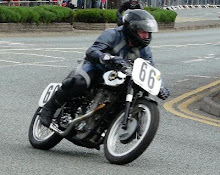
Kenny winning the 125 mile National at Willow Springs in April 1954, on the same bike he rode at Daytona just a month before.


Kenny on his 1952 BSA with Ang and Don Rossi, location unknown.


Kenny's 1952 BSA at Portland, Oregon. Couple posing behind are unknown!


Portland Meadows, Oregon 1954. No. 83 is Dick Mann on Kenny's 1952 A7 and no. 59 is Kenny on his 1954 A7. Dick won the ameatur and Kenny the expert. The gentlemen standing behind are Ang & Don Rossi, dealers & tuners from Santa Rosa.


Kenny and Bobby Hill at the 2004 50th anniversary celebrations at Daytona.

Tuesday, 10 February 2009

The BSA Super Flash Story

For one year only BSA made a super sports 650 pre-unit twin called the Super Flash.

It was conceived specifically for the US market and most of the 700 machines made went there. Little information was published about them in their short life and they are rarely mentioned in books about BSA history. Few have survived.


Why make a super sports twin? The Super Flash is the first example of a bike produced by BSA specifically for a particular market, in this case the USA. The requirements driving it's birth were simple - raw power.In early 1950's World War W II was five years distant, but many wartime restrictions remained.

In the monochrome austerity of continued rationing, fuel and housing shortages a motorcycle was for many people the only affordable means of transport. With manufacturing industry still picking it's way out of the ruins and crippled by US war debts, manufacturers were exhorted by their government to 'Export or die'. And the biggest market was the USA. Meanwhile in the US where the economy had largely recovered by 1946 and car ownership was widespread, motorcyles were for sports and leisure time. Consequently US buyers were more influenced by racing success than in the UK, and at that time this meant big Indian and Harley-Davidson(60 cubic inch V-twins.

By 1949, BSA had a US distributor and started making an impression on both leisure and sports riders. However, US AMA class 'C' restrictions meant that the OHV racing bikes bikes made by British manufacturers were limited to 500cc. Recognising the importance of the US market, BSA's chief designer Bert Hopwood went on a fact-finding mission in 1951 and met US dealers and riders. They made it very clear to him that if BSA wanted to increase it's sales presence it had to make bigger, faster bikes. On his return to the UK in 1951 the Super Flash was conceived.


What kind of bike? Bert Hopwood had certain constraints to work within. Since swinging arm frames and alloy heads were already in the planning stages a new model was out of the question. The bike would have to use as many existing parts as possible yet produce a bike that was much faster than the existing roadsters.
An impossible task? In fact BSA already had considerable experience. Veteran BSA competitor Fred Rist had been riding a tool room special 650 in sand races that could reach 140mph. A 650 ridden by Gene Thiessen had taken the AMA class 'B' record at 151mph at the Bonneville salt flats in October 1951. They had also been sending 500cc bikes to compete in the Daytona 200 that by 1953 could reach 130mph.

In the end there was no replacement for displacement so a 650cc or 40 cubic inch bike was made. The finished bike looked superficially like a plunger Gold Flash but with the obvious external differences kink in the seat post to accommodate the TT carb. Gold Star type chromed blade mudguards and stays were used. A 2.5 gallon tank Gold Star quick filler, chrome panels and metal tank badges was fitted with a unique 'Super Flash' decal on the tank top.
Inside however, the engine used many components that were not standard Gold Flash. In the press that accompanied it's launch these were described as 'special' though in reality their specification had probably been proven in the Rist, Thiessen and Daytona bikes.


The Super Flash had a brief life. First Super Flash is shipped in February 1953. In the same month American Motorcycling makes the bike 'Motor of the Month' with a 3 page review written by Roy Bradbury, general manager of the BSA's East coast distributor Rich Child Cycle co. This was reprinted later by BSA and used as a 4 page advertising brochure. In April 1953 the first bikes appear in US showrooms. In June 1953 BSA issues a list of parts to dealers as service bulletin no. 4F. In August 1953 the "You can buy 'em bigger" ad appear in US mags. The bike is priced at $975.00. In October 1953 a colour A3 foldout brochure is printed, probably in time for the Earls Court Motorcycle show in November. In November 1953 the Super Flash parts list appears as an appendix at the back of the 'A' models twin cylinder spares book. In the same month, the last Super Flash leaves BSA.

Initially, almost all Super Flashes were shipped to the US. But by the Autumn US shipments slowed down and machines began to be shipped to BSA dealers in Europe, Africa, Australia and the far east. Midway through 1953 BSA had already demonstrated a swing arm frame so most people knew it was on the way. Enthusiasts had also guessed that a new range of alloy head twins was being planned for 1954. With it's plunger frame and iron head the Super Flash would have seemed a dinosaur in comparison so potential buyers, unless desperate, would have waited for the new models. As US sales evaporated BSA tried harder to sell remaining Super Flashes any way they could.

Shipping records and anecdotes from owners suggests that the machine specification was changed either to use surplus parts or by customising to seal a deal. Things like changes in mudguard type, tank size, mudguard stays, handlebars and colours. The most significant change was to use a swing arm frame on some of the very last models shipped in late '53 and early '54. With this change and the appearance of the alloy head Road Rocket imminent, the game was pretty well up for the Super Flash. In a production life of about 1 year around 700 machines were built in all.

Why have so few survived? Of the 700 or so made, very few have survived. At a casual glance the Super Flash doesn't have much to distinguish it from any other old pre-unit BSA iron head twin. BSA pre-unit twins have never been considered glamorous and would have been treated accordingly when the mechanical 'end' came. Left for dead in garage corners, thrown in the river or a skip - many Super Flashes must have met the same fate. One of the reasons for appearing on this blog is to provide information that will help unearth bikes currently lying unidentified in workshop corners. It will also bring owners and information together to help get more bikes on the road.

If you wanted to create a classic motorcycling legend from scratch the sports specification, short production life and low survival rate could almost be used as a template. But the Super Flash isn't a legend because it is simply too obscure. It has managed to excuse itself from published BSA histories by being a US only model - most of the books are written in the UK, by UK historians about the bikes BSA made for the UK.

And the reason for its existence is much more mundane. Like the later Rocket Gold Star the Super Flash was a 'bitsa' put together using parts that were mostly already available in the product range or had been tried and tested in the competition shop.

It was a stop-gap machine made in sufficient numbers to qualify for US AMA class 'C' racing until Bert Hopwood's product rationalisation programme bore fruit with the swing-arm frame and A/B series gearbox in 1954. But what a stop-gap!

Monday, 9 February 2009

Roland Pike Autobiography - Chapter 30

Summary of development work

Rather than trying to visually compare inlet ports, we found it best to compare by measuring capacity with valve fitted in cc's using a burette, several engines that were down for power were found to be smaller capacity; 136cc instead of 148cc on an A7 twin, a B34 GS port 117cc extension 128 total induction 245cc.

All bench tests were carried out in uniform manner starting at lowest practical RPM and going up in increments of 250 RPM with no pause. Flash readings were never reported. We did try running power curves in reverse order starting at maximum revs and coming down but decided this gave false high readings.

Sandilands discovered almost by accident that a venturi shape after the carburettor can be 85% of the area of the carburettor body area with no loss of power, in fact it gave a small increase. We did most of our power curves with a flow meter hooked up between fuel tank and carburettor, this gives a valuable check on efficiency and also on correct carburettor settings.

When using two into one exhaust system it is desirable to have each pipe from the cylinder head to the junction of equal length if not carburation may be drastically affected at some point in the range. The way to avoid this problem is to ensure that each pipe has the same length to area ratio, in other words the longer piece will be larger diameter. In our experiments with the short stroke 500cc A7 twin we also found the angle of the two pipes at their intersection was important. I was at MIRA once waiting to use the timing strip whilst a group of Royal Enfield people tried to get the carburation right on one of the 700cc twins fitted with a two into one exhaust system, I noticed they were using the same diameter exhaust pipes of different lengths before the junction. Strangely enough this same rule holds good for induction pipes as found by Guzzi on their later single cylinder racers.

The A7 and A10 connecting rod bolts were originally BSF threads, we changed this to 26 threads per inch cycle threads as we thought larger area at the root of the thread would make a stronger bolt, we had to reduce torque when tightening the big end nuts proportionally, unfortunately someone in the drawing office forgot to tell the engine assembly and several bolts were broken before the error was discovered. Even more strange was the fact the broken bolts only happened to one of the several mechanics assembling the crank assemblies. I was asked to investigate, so sent Arthur Butler up to the engine assembly to watch how they did this torquing up. He returned a little later laughing with a small tobacco tin in his hand, It had plumbers tallow in it, apparently only one mechanic was putting tallow on the threads before tightening, with the results that nuts tightened appreciably more before the torque wrench recorded the correct torque figures. We accordingly tested some bolts with various lubricants on the thread and decided that important bolts such as connecting rod bolts should be assembled clean.

Oil Pumps.The BSA gear type pump is very simple and reliable, at one time we did some tests by simply running a pump on a drill press in a can of oil and measuring the temperature of the oil, we were surprised at how quickly the temperature rose especially as there was not resistance to the flow. On examination of the pump we decided that some oil was being compressed between the two gears, accordingly a small bypass was cut in the cover plate allowing oil to feed back to the inlet side of the pump. Further testing showed practically no heat build up in the oil. Some tests were carried out on A7 (using various viscosity oils, starting with 50 wt and coming down to 40 wt to 30 wt, 20 wt SAE 10 and finally 5 wt. We discovered that normal oil pressure was maintained on the SAE 10 50 wt, 40 wt and 30 wt. At SAE 20 viscosity pressure tended to drop particularly when hot. The engine was stripped at this point to see if the low pressure caused any bearing problems, everything looked pretty good. At SAE 10 wt pressure seemed very low in fact when hot was nil a further examination of the bearings and pistons showed no sign of trouble but the cam followers did not look too happy, starting to score.

A final run was made with SAE 5 wt pressure almost nil when cold, showed nil when hot especially when engine was revved up, finally the timing side main bearing failed. On stripping the engine we found the white metal had melted and run, but no trace of it in the oil or crankcase, when the sealing plugs were removed from the crankshaft the white metal, was found to be inside the oil passages of the crankshaft, the connecting rod bearings appeared to be in good condition. Apparently the light 5 wt oil was thrown outwards to the big end bearings by centrifugal force enough to lubricate the big end bearings adequately but in such quantity that it robbed oil from the main bearings faster than the oil pump could replace it.

One interesting test was when we set up a A10 engine and gearbox unit on the test bed driving the dyno by a short chain, the object was to try and measure the power loss in the gearbox in each gear. We could not measure the power in 1st gear as the dyno was turning too slowly to absorb the considerable torque due to the low gear ratio. As we expected the most efficient gear was 4th, the direct gear.

Surprisingly, 2nd gear was more efficient than 3rd gear due presumably to the fact that 2nd gear wheels were better supported than 3rd. The final part of the test was when we removed the gearbox and clutch and tried to run a fairly long chain from the engine to the dyno direct to see what difference was with gearbox out of action. To our surprise it could not be done, this rather long chain just whipped and banged and would not transmit power. We had to move the engine back on the block and used a short chain. Incidentally the power loss in 3rd gear was about 10% with about 8% loss in 2nd gear as compared with 4th gear with only 2%. One of the lesser known advantages of the eccentric rocker spindles is the ability to adjust the valves whilst the engine is running.

I suggested this to Reg Wilkes one day, however, he did not seem very keen to stand astride a high revving engine with a wrench in either hand so I appointed myself as the rocker manipulator. We started off on the 500 Gold Star race engine at about 5000 rpm with me firmly astride and adjusted each rocker until the maximum power reading was obtained. The engine was then blown cool with the fan and clearance checked, the inlet figure was something like .009" and exhaust a little more. Then the engine was run at 6000rpm and again rockers adjusted for maximum power and cooled down to room temperature and clearances checked, this time the inlet was .006" and exhaust .008".

Next a reading was taken at 6500 rpm and again clearances checked when cool. Now the inlet clearance was down to about .003" and exhaust .006", subsequent checks were made at 7000 rpm and 7500, with some pointed remarks made about what happened to me if the engine shuld blow up while I am astride it. The results at 7000 rpm were clearances Inlet .001" Exhaust .004" at 7500 rpm inlet nil, exhaust clearances .003". These were not exact figures (my memory is not that good) but the general trend was there at the higher revolutions the rockers and push rods were bending and whipping slightly.

Prior to these tests we had always set valve clearances with a cold engine, with inlet push rod just free to rotate and .003" clearance on the exhaust. The normal practice with regard to rocker angle in relation to valve stem has been to arrange for the rocker to be at right angles to the valve stem at half lift, the object being to minimise side thrust and cut down on valve guide wear. In the course of experiments with both the C12 and the A7 engine better running at high revolutions could be obtained when the rocker was at right angles to the valve stem at about l/32"to 1/16" lift. It was thought that this arrangement aligned the valve seat with the valve seat in the head just as the valve was closing, whereas with the common setting at half lift, the rocker side thrust will tip the valve slightly in the guide when seating and will have to realign itself as it seats. At very high revolutions there is not enough time for this and some efficiency will be lost. On the C12 this was visible even by turning the engine by hand, by inserting some packing between the rocker mounts and the head we were able to see the improved action. It is quite possible that most overhead valve engines using rockers could benefit from this rearrangement of rocker angles.

One unexpected results when trying a much larger and stiffer crankpin with plain bearing was considerable difficulty in lining up the flywheel assembly, presumably the wider shoulders made the assembly more rigid. Engine gaskets between rocker box and cylinder head usually made of paper were replaced with metal corrugated gaskets, these could be used over and over again and sealed better.

During the five years I was at BSA doing engine development I was fortunate in attracting some very bright and enthusiastic mechanics and apprentices, they all contributed to the progress we made with development of the BSA range. There was tendency to specialise but most could handle anything that came in the shop. Jimmy Gibbard did most of the odd machinery jobs, Jack Turner did the intricate inlet port arrangements and exploited the extra down draft angles and straight ports. Reg Wilkes, Bert Hole, Arthur Butler, Arthur Bridgewood, Bill Bently and Alan Sandilands could handle any aspect of engine building , the apprentices who spent more than average time with us were Gordon Smith, Robert Trigg, Ray Beech, David Harris and John Taft. Albert Dyde, ??? Harrison Ward and Hill came into the shop later. We also had some colonials like Barry Stormont and Cohn Mather during the winter months. I learned a great deal and was able to try out many ideas that I could never have done in the ordinary way, for this I am grateful to Mr Hopwood and BSA for this opportunity.

One of the chief abilities necessary in this type of work is to be able to 'sell' ideas to the Management, something I was not very good at. Thanks to BSA sending me to the USA on business trips I decided to emigrate and have had an interesting life in USA becoming a citizen in 1982, finally having my own business and a and a decent workshop including a dynomometer. I have not lost interest in motorcycles and at 75 own a 250cc Kawasaki 'Ninja', a remarkable little machine with a performance in road trim better than my old racers. We still enjoy trips to Road Atlanta to watch the motor cycle road each year.