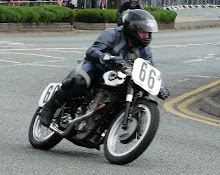
Of 250cc Gold Stars
During 1953 a Mr Thorpe persuaded Bert Perrigo that he should allow us to build a 250 Gold Star on a one off basis and a promise not to worry us for special tuning or special parts. I was quite keen to do this having always been interested in the 250 class. We had one of the experimental small valve scrambler heads left over and an experimental short 6" steel connecting rod, also a special pair of flywheels with crankpin holes specially machined to give 63 mm stroke. The crankpin was special for these short stroke flywheels in that the roller bearing in the centre was standard but the portion that fitted in the flywheels was smaller than usual, being 1.00" diameter and 0.00l taper giving a press fit, the nuts just keeping things together. With this very short stroke there was not room for the standard crankpin nuts. We made special long round nuts with a protruding hexagonal head these were cut off close to the pin after tightening. To remove them they were split with a chisel.
A standard 71mm bore piston and cylinder was used, suitably shortened. Alloy tubular pushrods were used, with lightened tappets, eccentric rocker spindles were used. After experimenting with several cams 22bhp was attained at 7000 – 7600RPM. The engine did not give as much power as the MC4 and it is quite likely that with further running the power increased but it proved very reliable and Mr Thorpe ran it for some years. Later on we built another Gold Star 250, this time using a one-piece crankshaft with outside flywheel and a Sunbeam S7 connecting rod with plain big end. This engine had a 1953 350 Gold Star head and cylinder barrel, the cylinder had to be shortened considerably only seven fins remaining. After quite a small amount of running 26.2bhp was obtained, then the inlet valve broke which ruined the head. When the engine was rebuilt a late type big fin cylinder head was used, a different cylinder head holding down arrangement was used, short steel tubes screwed into the crankcase, bolts fitted from the Back to top screwing into tubes, only four were used and we had no head blowing.
This was the final arrangement of our 250 Gold Star, it proved very successful, the best power recorded being 29.6 at 8250. It would run up to 9000 RPM quite reliably. The inlet port was a pressed in piece of alloy machined after fitting which gave a very straight port. Several engines were built to this design, one was a 350cc, using an 85 mm 500 Gold Star piston on a 61.5 stroke, this was later converted to a 250 by fitting a 72 mm Gold Star piston and was used in the Geoff Monty Special (GMS) for several years. Obviously these 250's were what could best be called ‘codge-ups' using 500 style crankcases for lack of a proper one, the cylinder heads being from 350s had unsuitable valve angles and sizes, the compression ratios were restricted, because of wide angle valves. In spite of these disadvantages proved in the GMS that this was the way to go. The lessons learnt from the ill-fated MC1 were not forgotten. The 250 Gold Star engine in a 500 Gold Star frame was timed at MIRA to do 108mph. In the GMS with some fairing it reached 115mph.
Showing posts with label BSA. Show all posts
Showing posts with label BSA. Show all posts
Sunday, 25 January 2009


Roland Pike Autobiography - Chapter 20
Tales of the Bantam C12, C15 & MC4
The BSA Bantam and the Harley Davidson Hummer were snatched from the Germans as 'reparations' after World War II. The Bantam started as a DKW in 1935 or 36 when it was considered modern with its flat Back to top piston, but by 1946 when BSA got it, it was already old fashioned. One could get about 4.5bhp from the 125cc if you were lucky, more often only about 3.5. The noise they made was dreadful and so was the oil they blew all over the test shop. We worked on them for a couple of years, making all sorts of experimental bits and pieces, none of which worked very well. I recall someone wanted to ride one in the International Six Days Trial and Bert Perrigo the BSA Competition manager persuaded us to build him a 'special'.
Reg Wilkes worked on it for a couple of weeks and got 5 or 6bhp over a wider range than the standard machine. Another time an Australian sent us under great secrecy his Bantam which was reputed to be very powerful and high revving and all the rest. It was highly modified and ran on alcohol blended fuel, they claimed 12bhp and had been timed to exceed 90mph We were suitably impressed and set it up on our dyno, we mixed the prescribed blend of fuel of alcohol benzole and acetone and ran it. However we could not stop it from four stroking and it would not give more than 6bhp. We were reluctant to jet it down in case we burned it up. So we gave up, deciding that the cold damp November air did not suit it, it apparently needed hot dry Aussie air.
In the development shop at BSA we used to hate the sound and sight of the Bantam. When I first went there we were responsible for Bantam development, but I disliked two strokes then and I still do. I suggested to Hopwood why didn’t he get Herman Meier who had been with on the Continental Circus trip in 1951 who was an enthusiast as I felt sure he would make them run. Finally after a lot of trouble with work permits and so on we got Herman over and he shared an office with me. He doubled the power of the Bantam in a few months. Unfortunately Herman was a temperamental type and I eventually recommended that he be moved to Redditch where the Bantams were made anyway. Here he got some good power outputs from the 125cc Bantam and developed the larger versions they eventually produced.
Occasionally a 250 C12 came into the shop, this was a simple and cheap engine, designed in 1935 as a light and inexpensive utility machine based on a Blackburn design used by Excelsior and Frances Barnett a year or earlier. It was novel in that the push rods crossed in the tunnel at the same angle as the valves.
One day the C12 production line was stopped due to repeated complaints from the Dealers of 'knock' from the engine. Mr Leake called a meeting of everyone concerned and told us to cure it or it would have to be dropped from production. A big panic ensued, several engines that were 'knockers' were brought into my shop and we found the in some cases the knock could be cured by retarding the ignition very slightly, but some of the worst examples 'knocked' regardless of timing etc. These were stripped right down for thorough examination, we noticed that the flywheels were made of cast iron whereas when the engine was first produced it had flywheels of steel stampings. We were able to get some of these and when fitted to the worst offenders it completely cured the problem. Whilst fiddling with C12 250cc we tried the alloy cylinder head from the Ariel Colt, a 200cc version of the same engine, this cylinder head cured 'knocking' and gave more power, which prompted us to make a 'deluxe' C12 which after a few quite simple modifications gave 15bhp. An engine was passed to the experimental dept for road testing, but I do not remember any conclusions being made and soon after the 015 was designed. This was another 'cheap' design based on the Triumph Terrier 150cc. In my opinion a poor thing.
The MC4 design which was very promising was essentially half an A7 twin, the better half I thought as it was more reliable than the A7. It was intended to make a 350cc version using A10 parts. This would have been helpful to the production people as so many parts would have been interchangeable. The camshaft had to be different of course for a single cylinder. The original design used a one-piece iron casting unfortunately the cast iron was not up to the job and the first one broke, possibly 'Nodular' iron would have done the trick or the larger crankpin as used later in A7 & A10 would have helped. At about this time (1952) we used our first alternators built into the engine timing case, this gave it an odd shaped bulge, they worked very well and used less horsepower than the regular generator with rotating armature. I think if it had gone into production some resistance would have been encountered from the typical motor cyclist over the odd appearance of this engine, but once they realised the advantages of the engine they would soon forget the appearance.
The MC4 gave half the power of the racing A7 but with much greater reliability. This could only be explained by the fact that the main bearings were only some three inches apart giving an inherently more rigid lower end than the A7, which suffered from crankshaft whip. One of the things we learned a lot about during the MC4 development was mechanical berathers. As designed it had a disc valve breather as on the earlier Gold Star, at high revolutions the little pen steel disc valve could not cope and as a result blew oil out in large amounts. The same problem on the early Gold Star caused several retirements in the Clubmans TT races due to loss of oil and too much oil on the rear tire became very mechanical breather conscious and tried to adapt the A7 mechanical breather to the MC4. At first it would not work satisfactorily finally we fitted copper pipe inside the crankcase, picking up breather air from a 'dry' spot in the corner of the crankcase. This was much more effective in terms of oil loss, but the crankcase pressure was disappointing until we retarded the timing of the breather valve by 70 degrees, it would then maintain a pressure inside the crankcase of between of 4 and 7 inches of water lower than atmospheric at all speeds. This kept the engine very clean, even when belting round MonthIery track at nearly 100mph.
Due to the MIRA test track not being completed we arranged to go to France and use the banked track at Monthlery for a week. We.loaded the MC4, a 350 Gold Star and two 650 A10 Police Specials into our van, which was my old race van which I had bought from Ray Amm in 1952, now fitted' with a V8 engine. Charlie Salt and I were the hobbledeboys, we drove the van via Dover and Boulogne to Paris. Arthur Lupton and Bert Hopwood drove an A40 Austin. Bill Nichols flew out to join us a little later. Strangely enough although Bill was such a dare-devil in Scrambles and on the road, he was completely over-awed by the banked track. He was unable to lap as fast as I did and I was putting on weight and my leathers were tight. Charlie being neat and slim lapped about 3mph faster than I did and I was a little faster than Bill. The demonstration of the police bikes to the National Guard was the funniest thing. The police were all Triumph enthusiasts and did not like BSAs. When our bikes lapped faster than the Police Triumphs they removed the silencers, saying "now we will go faster". We wondered whether we should remove our silencers as well and go faster still, but it was getting ridiculous. Their police model Triumph had the infamous sprung hub and at speed on the banking looked positively dangerous. It started to drizzle with rain and I thought now we will show them, our bikes had the old plunger springing, it seemed steadier than the Triumph on the banking. However they would not ride on the track in the wet. I did a couple of fast laps in the wet at about 103mph and was skating about all over the place. So we adjourned for lunch with the Distributor and his guests from the Guard Nationale. We spent the rest of our time there testing the MC4 and found the heavy front mudguards were holding our speed down to 93mph, so we removed front mudguard and tipped the headlamp to try and improve the streamlining - we could not remove jt because it contained switchgear etc. The bike was road equipped except for a megaphone in place of the silencer. This put the speed up to 96 for the lap. When timed the Gold Star and Charlie slipstreamed me on the MC4 we lapped at just on 99mph. When we switched bikes we could lap at 97. For a 250cc push rod machine which was not designed as a racer these times were very good, the engine was putting out about 24.5bhp. The racing Excelsior 250 claimed 22.5bhp on 50/50 petrol benzole. We were using pump fuel of 78 octane. However when we returned to the factory the Board of Directors decided against producing the MC4 which was a great disappointment to all of us, we who had seen its promise. A version was assembled with sheet metal covering over crankcase and gearbox, a different colour scheme and Sunbeam name on the tank, this was also turned, down. The C12 and its variations stayed in production.
The BSA Bantam and the Harley Davidson Hummer were snatched from the Germans as 'reparations' after World War II. The Bantam started as a DKW in 1935 or 36 when it was considered modern with its flat Back to top piston, but by 1946 when BSA got it, it was already old fashioned. One could get about 4.5bhp from the 125cc if you were lucky, more often only about 3.5. The noise they made was dreadful and so was the oil they blew all over the test shop. We worked on them for a couple of years, making all sorts of experimental bits and pieces, none of which worked very well. I recall someone wanted to ride one in the International Six Days Trial and Bert Perrigo the BSA Competition manager persuaded us to build him a 'special'.
Reg Wilkes worked on it for a couple of weeks and got 5 or 6bhp over a wider range than the standard machine. Another time an Australian sent us under great secrecy his Bantam which was reputed to be very powerful and high revving and all the rest. It was highly modified and ran on alcohol blended fuel, they claimed 12bhp and had been timed to exceed 90mph We were suitably impressed and set it up on our dyno, we mixed the prescribed blend of fuel of alcohol benzole and acetone and ran it. However we could not stop it from four stroking and it would not give more than 6bhp. We were reluctant to jet it down in case we burned it up. So we gave up, deciding that the cold damp November air did not suit it, it apparently needed hot dry Aussie air.
In the development shop at BSA we used to hate the sound and sight of the Bantam. When I first went there we were responsible for Bantam development, but I disliked two strokes then and I still do. I suggested to Hopwood why didn’t he get Herman Meier who had been with on the Continental Circus trip in 1951 who was an enthusiast as I felt sure he would make them run. Finally after a lot of trouble with work permits and so on we got Herman over and he shared an office with me. He doubled the power of the Bantam in a few months. Unfortunately Herman was a temperamental type and I eventually recommended that he be moved to Redditch where the Bantams were made anyway. Here he got some good power outputs from the 125cc Bantam and developed the larger versions they eventually produced.
Occasionally a 250 C12 came into the shop, this was a simple and cheap engine, designed in 1935 as a light and inexpensive utility machine based on a Blackburn design used by Excelsior and Frances Barnett a year or earlier. It was novel in that the push rods crossed in the tunnel at the same angle as the valves.
One day the C12 production line was stopped due to repeated complaints from the Dealers of 'knock' from the engine. Mr Leake called a meeting of everyone concerned and told us to cure it or it would have to be dropped from production. A big panic ensued, several engines that were 'knockers' were brought into my shop and we found the in some cases the knock could be cured by retarding the ignition very slightly, but some of the worst examples 'knocked' regardless of timing etc. These were stripped right down for thorough examination, we noticed that the flywheels were made of cast iron whereas when the engine was first produced it had flywheels of steel stampings. We were able to get some of these and when fitted to the worst offenders it completely cured the problem. Whilst fiddling with C12 250cc we tried the alloy cylinder head from the Ariel Colt, a 200cc version of the same engine, this cylinder head cured 'knocking' and gave more power, which prompted us to make a 'deluxe' C12 which after a few quite simple modifications gave 15bhp. An engine was passed to the experimental dept for road testing, but I do not remember any conclusions being made and soon after the 015 was designed. This was another 'cheap' design based on the Triumph Terrier 150cc. In my opinion a poor thing.
The MC4 design which was very promising was essentially half an A7 twin, the better half I thought as it was more reliable than the A7. It was intended to make a 350cc version using A10 parts. This would have been helpful to the production people as so many parts would have been interchangeable. The camshaft had to be different of course for a single cylinder. The original design used a one-piece iron casting unfortunately the cast iron was not up to the job and the first one broke, possibly 'Nodular' iron would have done the trick or the larger crankpin as used later in A7 & A10 would have helped. At about this time (1952) we used our first alternators built into the engine timing case, this gave it an odd shaped bulge, they worked very well and used less horsepower than the regular generator with rotating armature. I think if it had gone into production some resistance would have been encountered from the typical motor cyclist over the odd appearance of this engine, but once they realised the advantages of the engine they would soon forget the appearance.
The MC4 gave half the power of the racing A7 but with much greater reliability. This could only be explained by the fact that the main bearings were only some three inches apart giving an inherently more rigid lower end than the A7, which suffered from crankshaft whip. One of the things we learned a lot about during the MC4 development was mechanical berathers. As designed it had a disc valve breather as on the earlier Gold Star, at high revolutions the little pen steel disc valve could not cope and as a result blew oil out in large amounts. The same problem on the early Gold Star caused several retirements in the Clubmans TT races due to loss of oil and too much oil on the rear tire became very mechanical breather conscious and tried to adapt the A7 mechanical breather to the MC4. At first it would not work satisfactorily finally we fitted copper pipe inside the crankcase, picking up breather air from a 'dry' spot in the corner of the crankcase. This was much more effective in terms of oil loss, but the crankcase pressure was disappointing until we retarded the timing of the breather valve by 70 degrees, it would then maintain a pressure inside the crankcase of between of 4 and 7 inches of water lower than atmospheric at all speeds. This kept the engine very clean, even when belting round MonthIery track at nearly 100mph.
Due to the MIRA test track not being completed we arranged to go to France and use the banked track at Monthlery for a week. We.loaded the MC4, a 350 Gold Star and two 650 A10 Police Specials into our van, which was my old race van which I had bought from Ray Amm in 1952, now fitted' with a V8 engine. Charlie Salt and I were the hobbledeboys, we drove the van via Dover and Boulogne to Paris. Arthur Lupton and Bert Hopwood drove an A40 Austin. Bill Nichols flew out to join us a little later. Strangely enough although Bill was such a dare-devil in Scrambles and on the road, he was completely over-awed by the banked track. He was unable to lap as fast as I did and I was putting on weight and my leathers were tight. Charlie being neat and slim lapped about 3mph faster than I did and I was a little faster than Bill. The demonstration of the police bikes to the National Guard was the funniest thing. The police were all Triumph enthusiasts and did not like BSAs. When our bikes lapped faster than the Police Triumphs they removed the silencers, saying "now we will go faster". We wondered whether we should remove our silencers as well and go faster still, but it was getting ridiculous. Their police model Triumph had the infamous sprung hub and at speed on the banking looked positively dangerous. It started to drizzle with rain and I thought now we will show them, our bikes had the old plunger springing, it seemed steadier than the Triumph on the banking. However they would not ride on the track in the wet. I did a couple of fast laps in the wet at about 103mph and was skating about all over the place. So we adjourned for lunch with the Distributor and his guests from the Guard Nationale. We spent the rest of our time there testing the MC4 and found the heavy front mudguards were holding our speed down to 93mph, so we removed front mudguard and tipped the headlamp to try and improve the streamlining - we could not remove jt because it contained switchgear etc. The bike was road equipped except for a megaphone in place of the silencer. This put the speed up to 96 for the lap. When timed the Gold Star and Charlie slipstreamed me on the MC4 we lapped at just on 99mph. When we switched bikes we could lap at 97. For a 250cc push rod machine which was not designed as a racer these times were very good, the engine was putting out about 24.5bhp. The racing Excelsior 250 claimed 22.5bhp on 50/50 petrol benzole. We were using pump fuel of 78 octane. However when we returned to the factory the Board of Directors decided against producing the MC4 which was a great disappointment to all of us, we who had seen its promise. A version was assembled with sheet metal covering over crankcase and gearbox, a different colour scheme and Sunbeam name on the tank, this was also turned, down. The C12 and its variations stayed in production.
Saturday, 24 January 2009
Roland Pike Autobiography - Chapter 19
The Importance of the Export Market
After the war Sir Stafford Cripps devalued the pound sterling to help Britain compete in the export markets, but unfortunately few businessmen appreciated the value of exports. I did not realise it myself until I was sent to America by BSA, then I realised Britain needed dollars to buy food, raw materials and fuel and to get them we had to export. To export you have got to give the customer what they want and that is what I tried to do at BSA. To be sure, Mr Rawson their Export Manager and Mr Leake were aware of the need for exports, but it was on the factory floor that this was not appreciated. Anything special was a nuisance it was an uphill job. I was not high-up enough to carry any weight.
Bert Hopwood and Bert Perrigo understood and did what they could and Mr Leake managed to give the Americans what they wanted. BSA had two representatives in the United States, Hap Alzina on the West coast and Alf Child of Rich Child Cycle company on the East. Alf Child was a great promoter, no doubt about it, but unfortunately he did not understand motor cycles as well as Hap Alzina. Mr Childs depended on others for the technical or specialised advice so that some of the information he gave us was not always good. As a result a lot of what he told us was disregarded, good or bad. Hap Alzina was just the opposite and was a pillar of strength, supporting the design and technical depts wherever he could. He was able to pull strings with the AMA that Alf Child could never do.
Alf Childs was British, born in Nutley, Sussex, UK. He ran away to sea when he was only 14. He had lost an arm and was known inevitably as the 'one-armed bandit' in New Jersey. He was a flamboyant character and often rude to people, but once you got to know him was very likeable. At first you could be very put off by him as he had a habit of being abusive and used the most crude language, not just about things but personal with it. At that time I did not understand his attitude and took offense. I intimated to Mr Leake that I did not want to visit Alf Child in the US anymore.
Finally Mr Leake found out my complaint and gave Alf Child a dressing down. I was sent back to America in 1953 for Daytona, during this visit I listened carefully to what the Dealers, their riders, Tommy McDermott, Warren Sherwood, Gene Thiessen and Al Gunter had to say and went back to the factory and explained to them that BSA had to produce a bike entirely for the American competition market. As a result I was given the go ahead to produce a prototype. I used one of Bill Nicholson’s production trials frames, welded light and rigid. The Dealers in America had said Daytona is only one race a year and we were putting everything into it, what would they do with the bikes afterwards? They were no good for the half-mile as they were too heavy, they wanted something light. So I decided that they could get something light and produced a prototype that weighed 276lbs by using a lot of light alloys, fitted with a Gold Star engine, it would do 114mph on the timing strip, mean speed.
The twin engine in the meantime had been developed to give more power and reliability using an alloy head and a hot cam, the power was available from about 5250 to 7250 RPM, but it was not so tractable as the single although it gave more power and was 2mph faster on the timing strip. Running side by side the single would reach the end of the timing strip first, although finishing the measured mile at a lower speed. We went to Daytona in 1954 with eight rigid frame lightweight racers, four with singles and four twins. Alf Childs wanted an extra bike for Bobby Hill, all we had available was a 500cc twin in a Clubmans type spring frame, ironically this was the winning machine! We collected five of first eight places, the best BSA ever did at Daytona.
The AMA at this time were very strict with compression ratios, the maximum allowed was 8:1, we were allowed 1 mm oversize pistons, so naturally all these bikes had the extra few cc capacity (508cc) and it did give a wee bit more power. BSA made 100 of these rigid frame, short track machines and some were still being raced on half mile and mile circuits twenty three years later. Later on the AMA allowed up to 9:1 compression ratio, which was more helpful to the twins than the singles. By 1958 the factory was not giving much support to the American racers. I remember we had difficulty in obtaining Nirnonic 80 valves in the US. Nimonic 80 is made by Henry Wiggins in the UK and should be readily available. A similar material is available in the States under a similar name.
An overhead valve engine running at high speed presents a difficult problem for the valves due to the weight of the push rods, tappets and rockers the valve springs have to be fairly powerful which in turn puts a load on the valves, particularly the exhaust valve which runs at bright red heat. A Gold Star running under full load and full throttle can demonstrate this, just look into the carburettor intake, a small segment of the exhaust valve is visible glowing red hot . The British motorcycle industry was at its peak of success in the days when people rode their motor cycles to work as well as for pleasure, owning a car was not so affordable then and the bike was much more convenient than bus, train or tram.
I think motor cycles are a viable solution to the future need for low cost transportation and with ever increasing costs of fuel. The bike takes up less room on our crowded highways. The utility bike of the future may well be a 250 single or a 350 twin, these could easily give 80 mpg, US or imperial! Bikes for Class 'C' Racing. When I first had anything to do with Class 'C', we felt very restricted due to the strict regulations. 8:1 compression ratio, kick- starters etc. Any competitor in a race could claim the winners bike on payment of $1500. This was to discourage excessive investment of money and time into a certain machine by the factory or dealer, and to ensure that all the race bikes were reasonably equal in performance. In other words a no-hope rider could theoretically buy himself the best machine at a race by simply claiming it. In practice this did not happen too often because anyone who did this would be regarded as un-sporting. I heard of a case where a bike was claimed and the factory concerned bought the would-be purchaser off by offering him more money not to claim it. Any special machines had to be approved by the AMA and at least 100 produced for sale to dealers. In 1953 we had got into quite an argument over this rule. BSA claimed the 1953 racer was a Star Twin with a few modifications that were available to the public. The AMA did not agree and told us we had to make a 100. Since we had not had any good results with the model, we knew we would never sell a 100 of them and finally made about 40 or so.
I remember Fron Purslow bought one and tried to race it in England on short circuits, with no success. One of the friendliest racers I met at Daytona was Al Gunter in 1953 and last saw him at Daytona in 1958 by which time he was a changed man. He had been terribly mutilated in various crashes although you saw flashes of the old Al Gunter in the smile and enthusiasm. He had tried to make a career out of motor cycle racing in the 50's, this was difficult and as he got older had to compete with many up and coming younger riders. Eventually he was confined to a wheelchair and in 1976 we heard of his suicide. Al Gunter had been a very enthusiastic racer of BSA's and co-operated a great deal in our experiments. In the mid '50's he was one of the fastest BSA men in the USA. The last time I talked with him, Al said he was getting over 50bhp at the back wheel of his Gold Star racer at 8000 RPM.
Harman and Collins helped him in these experiments, using special cams and special push rods to aid higher revving. At 8000 RPM I did not expect a Gold Star to last very long, which Al confirmed and said the motor was only good for a short track. Dick Mann another BSA rider who was riding Harley Davidson at Daytona in 1958. One time he handed me a factory racing Harley 45 cu. inch, flathead twin and asked if I had ever had a ride on one. I had not and he suggested I have a go. This was in front of all the Harley people and their eyes were popping out. Before anyone could stop me I hopped on and a rushed up the beach. It was fantastic and felt like a Manx Norton. It steered well, brakes were good, the motor pulled hard to 7400 RPM, then the power dropped right off and you went to the next gear. Torque was strong all the way. I don't know how our BSA riders ever competed with them.
Gold Stars that were raced on other US tracks got a certain amount help from the Distributors but the factory support was very limited. S&W valve springs came to our attention through Hap Alzina, he thought they might help the twins, they certainly did and Gold Star singles as well. We had tremendous success with them. According to theory they should not work! But then, theory says the Bumble Bee cannot fly.
After the war Sir Stafford Cripps devalued the pound sterling to help Britain compete in the export markets, but unfortunately few businessmen appreciated the value of exports. I did not realise it myself until I was sent to America by BSA, then I realised Britain needed dollars to buy food, raw materials and fuel and to get them we had to export. To export you have got to give the customer what they want and that is what I tried to do at BSA. To be sure, Mr Rawson their Export Manager and Mr Leake were aware of the need for exports, but it was on the factory floor that this was not appreciated. Anything special was a nuisance it was an uphill job. I was not high-up enough to carry any weight.
Bert Hopwood and Bert Perrigo understood and did what they could and Mr Leake managed to give the Americans what they wanted. BSA had two representatives in the United States, Hap Alzina on the West coast and Alf Child of Rich Child Cycle company on the East. Alf Child was a great promoter, no doubt about it, but unfortunately he did not understand motor cycles as well as Hap Alzina. Mr Childs depended on others for the technical or specialised advice so that some of the information he gave us was not always good. As a result a lot of what he told us was disregarded, good or bad. Hap Alzina was just the opposite and was a pillar of strength, supporting the design and technical depts wherever he could. He was able to pull strings with the AMA that Alf Child could never do.
Alf Childs was British, born in Nutley, Sussex, UK. He ran away to sea when he was only 14. He had lost an arm and was known inevitably as the 'one-armed bandit' in New Jersey. He was a flamboyant character and often rude to people, but once you got to know him was very likeable. At first you could be very put off by him as he had a habit of being abusive and used the most crude language, not just about things but personal with it. At that time I did not understand his attitude and took offense. I intimated to Mr Leake that I did not want to visit Alf Child in the US anymore.
Finally Mr Leake found out my complaint and gave Alf Child a dressing down. I was sent back to America in 1953 for Daytona, during this visit I listened carefully to what the Dealers, their riders, Tommy McDermott, Warren Sherwood, Gene Thiessen and Al Gunter had to say and went back to the factory and explained to them that BSA had to produce a bike entirely for the American competition market. As a result I was given the go ahead to produce a prototype. I used one of Bill Nicholson’s production trials frames, welded light and rigid. The Dealers in America had said Daytona is only one race a year and we were putting everything into it, what would they do with the bikes afterwards? They were no good for the half-mile as they were too heavy, they wanted something light. So I decided that they could get something light and produced a prototype that weighed 276lbs by using a lot of light alloys, fitted with a Gold Star engine, it would do 114mph on the timing strip, mean speed.
The twin engine in the meantime had been developed to give more power and reliability using an alloy head and a hot cam, the power was available from about 5250 to 7250 RPM, but it was not so tractable as the single although it gave more power and was 2mph faster on the timing strip. Running side by side the single would reach the end of the timing strip first, although finishing the measured mile at a lower speed. We went to Daytona in 1954 with eight rigid frame lightweight racers, four with singles and four twins. Alf Childs wanted an extra bike for Bobby Hill, all we had available was a 500cc twin in a Clubmans type spring frame, ironically this was the winning machine! We collected five of first eight places, the best BSA ever did at Daytona.
The AMA at this time were very strict with compression ratios, the maximum allowed was 8:1, we were allowed 1 mm oversize pistons, so naturally all these bikes had the extra few cc capacity (508cc) and it did give a wee bit more power. BSA made 100 of these rigid frame, short track machines and some were still being raced on half mile and mile circuits twenty three years later. Later on the AMA allowed up to 9:1 compression ratio, which was more helpful to the twins than the singles. By 1958 the factory was not giving much support to the American racers. I remember we had difficulty in obtaining Nirnonic 80 valves in the US. Nimonic 80 is made by Henry Wiggins in the UK and should be readily available. A similar material is available in the States under a similar name.
An overhead valve engine running at high speed presents a difficult problem for the valves due to the weight of the push rods, tappets and rockers the valve springs have to be fairly powerful which in turn puts a load on the valves, particularly the exhaust valve which runs at bright red heat. A Gold Star running under full load and full throttle can demonstrate this, just look into the carburettor intake, a small segment of the exhaust valve is visible glowing red hot . The British motorcycle industry was at its peak of success in the days when people rode their motor cycles to work as well as for pleasure, owning a car was not so affordable then and the bike was much more convenient than bus, train or tram.
I think motor cycles are a viable solution to the future need for low cost transportation and with ever increasing costs of fuel. The bike takes up less room on our crowded highways. The utility bike of the future may well be a 250 single or a 350 twin, these could easily give 80 mpg, US or imperial! Bikes for Class 'C' Racing. When I first had anything to do with Class 'C', we felt very restricted due to the strict regulations. 8:1 compression ratio, kick- starters etc. Any competitor in a race could claim the winners bike on payment of $1500. This was to discourage excessive investment of money and time into a certain machine by the factory or dealer, and to ensure that all the race bikes were reasonably equal in performance. In other words a no-hope rider could theoretically buy himself the best machine at a race by simply claiming it. In practice this did not happen too often because anyone who did this would be regarded as un-sporting. I heard of a case where a bike was claimed and the factory concerned bought the would-be purchaser off by offering him more money not to claim it. Any special machines had to be approved by the AMA and at least 100 produced for sale to dealers. In 1953 we had got into quite an argument over this rule. BSA claimed the 1953 racer was a Star Twin with a few modifications that were available to the public. The AMA did not agree and told us we had to make a 100. Since we had not had any good results with the model, we knew we would never sell a 100 of them and finally made about 40 or so.
I remember Fron Purslow bought one and tried to race it in England on short circuits, with no success. One of the friendliest racers I met at Daytona was Al Gunter in 1953 and last saw him at Daytona in 1958 by which time he was a changed man. He had been terribly mutilated in various crashes although you saw flashes of the old Al Gunter in the smile and enthusiasm. He had tried to make a career out of motor cycle racing in the 50's, this was difficult and as he got older had to compete with many up and coming younger riders. Eventually he was confined to a wheelchair and in 1976 we heard of his suicide. Al Gunter had been a very enthusiastic racer of BSA's and co-operated a great deal in our experiments. In the mid '50's he was one of the fastest BSA men in the USA. The last time I talked with him, Al said he was getting over 50bhp at the back wheel of his Gold Star racer at 8000 RPM.
Harman and Collins helped him in these experiments, using special cams and special push rods to aid higher revving. At 8000 RPM I did not expect a Gold Star to last very long, which Al confirmed and said the motor was only good for a short track. Dick Mann another BSA rider who was riding Harley Davidson at Daytona in 1958. One time he handed me a factory racing Harley 45 cu. inch, flathead twin and asked if I had ever had a ride on one. I had not and he suggested I have a go. This was in front of all the Harley people and their eyes were popping out. Before anyone could stop me I hopped on and a rushed up the beach. It was fantastic and felt like a Manx Norton. It steered well, brakes were good, the motor pulled hard to 7400 RPM, then the power dropped right off and you went to the next gear. Torque was strong all the way. I don't know how our BSA riders ever competed with them.
Gold Stars that were raced on other US tracks got a certain amount help from the Distributors but the factory support was very limited. S&W valve springs came to our attention through Hap Alzina, he thought they might help the twins, they certainly did and Gold Star singles as well. We had tremendous success with them. According to theory they should not work! But then, theory says the Bumble Bee cannot fly.
Tuesday, 13 January 2009
Roland Pike Autobiography Chapter 18
The Development Shop and Clubmans TT
The primary aim of my development shop at BSA apart from improving standard machines was to win the Clubmans TT. We were not supposed to be interested in International racing, other than in connection with the MC1 project. The scrambler motor was considered powerful enough. For the Clubmans models we were always searching for a little more speed and of course reliability. This went hand in hand with American class ‘C’ AMA racing, since what was good for the Clubmans was also good for class ‘C’.
BSA did not dominate the early Clubmans 500cc TT races which were won mainly by Triumph and Norton. The 1949 race for 350cc was BSA's first victory. Many BSA 350's were entered and few finished but that year the winner was a BSA.
They had plunger rear suspension, leaked oil, and tended to blow oil out of the engine breather, to the extent of running low on oil, causing seizures etc. Nevertheless, the two or three best BSAs on that occasion did very well, competing against Velocette KSS models and 350 Norton Internationals. In 1952 BSA had hoped to provide a challenge in the 500cc Clubmans with an all alloy twin engine which would be promoted as Gold Star Twin if successful.
However the regulations prevented their use as it was not yet a production model. A few standard A7 500cc twins were built to Clubmans specifications, they pushed out 36-38bhp which was about the same as the production Manx Norton, but in fact were unreliable and had a peaky performance, also did not handle as well as the single. In 1953 it was the same story, the old CB350 did quite well as did the 500cc singles of which there were two or three entered.
The 500cc BSA twins were getting pretty unpopular by that time because when the crankshaft broke, they often destroyed the crankcases and fetched the rider off. If this happens at 100mph it’s pretty scary. Triumphs were still going strong with their 500cc twins although they had their share of blown engines too. They won by the use of specially prepared hand picked machines and some good riders. By 1954 the Gold Star had new heads with big area finning, eccentric rocker spindles, shorter connecting rods, tubular push rods (instead of solid alloy) and Nimonic exhaust valves, a timed crankcase breather (which controlled the tendency to blow oil out on to the road and rear tires) and needle roller bearings on the gearbox layshaft. So far as factory involvement in preparing machines for the Clubmans went there was none, however we used to maintain a workshop in the Island for the benefit of all riders of BSAs. The riders who showed the best in practice might get the benefit of someone like Cyril Halliburn working on their motors. Triumph and Norton did the same thing.
Triumph had Ernie Nott an ex- TT winner working on some of their customers’ bikes. I was in the Island workshop keeping an eye on technical problems and helping Charlie Salt with his TT machines. Before coming to BSA Hopwood had designed the Norton twin, its outstanding feature was the way the cylinder heads were splayed, cut at the front giving better cooling and more fins where needed. This feature was patented, so of course could not be used by BSA.
Nevertheless the new A7 he designed for 1952 was a good rugged engine compared with the earlier BSA twins. It had a weak point in the timing side main bearing and rather small tappets, they wore more rapidly than they should, and also a tendency to vibrate and break crankshafts. We carried out a lot of tests to improve the timing side main bearing trying an all white metal bearing, a copper-lead bearing and a needle roller bearing. This last was far and away the best but required a different oil feed to the crankshaft to lubricate the rod bearings but as the factory did not want to make a change, we continued with the short life main bearing. The crankshaft breakage problem was really due to two things, the diameter of the crankshaft rod bearing journals gave a natural frequency of vibration that coincided with 6,600 & 3,300 RPM, any prolonged full throttle running at 6,600 rpm soon broke the crank adjacent to the rod bearing journal.
A member in the Group Research dept. gave this matter some thought and came up with the answer - a better finish in the fillet radius each side of the big end journal. In production the journal radius was done by the same grinding wheel that ground the journal, this meant that tiny microscopic scratches were left and this is where the fatigue fractures invariably started. His solution was to roll under high pressure a ball around each journal, leaving a perfectly smooth finish.
The layout of the Test shop.There were five Heenan &Froude hydraulic dynamometers and one electric dyno, an elaborate set up ideal for research work. The electric dyno could be reversed to drive the engine you were testing. Everyone was half scared of it, except Arthur Bridgewood, he used it a lot. He insisted that there was always an apprentice standing with his hand on the big knife switch to cut it off dead, if an engine blew up whilst running, current would continue to flow rotating the already damaged engine to destruction. The operator had to be wide awake and act quickly if something broke or seized. We eventually traded this dyno to Research for a nearly new DPX1. The other dynos were two DPX2, one DPX0 and two DPX1. When the MC1 came into the shop we had a new high speed dyno- a DPX3 .
Originally all the dynos were driven by chain from the engine sprocket, a very inefficient method, but simple. We used a 2:1 ratio to keep things simple. Anyone who favours primary chain drive should attend a test using chain drive. At about 6000 RPM take a reading, then get a squirt oil can and oil the chain, the engine will pick up an apparent 2bhp.
Heenan used to recommend a shaft and two universal joints like in a car, but we found them unreliable, the universal joints used to break up and fly all over the shop like shrapnel. We eventually went to a bonded rubber coupling which if lined up carefully gave good results. All the dynamometers were arranged in a line with their axis parallel, very neat, but very impractical, as the blast of cooling air and exhaust blew from one to the next, making it impractical to use more than one engine at a time, due to blast of air and if testing a race engine the noise and fumes, to say nothing of oil.
To try to get away from these difficulties and to control the blowing oil we had some metal shields on castors made which could be rolled around behind the engines. When cooling air blowers were turned on the shields tended to move around, they soon got coated in oil and one had to avoid brushing against the oily surface. This system remained in used for some years until the shop was demolished. The development shop was once a stable, it was quite old, with over 30 foot ceiling and heated by steam pipes. In summer the only cooling was by opening ventilators.
Originally there was no provision for letting air and fumes out, so a rather expensive sheet metal ducting system was built with a 6 hp fan drawing air from just behind each engine. Cooling air was blown over each engine by a powerful 'squirrel cage' blower, giving an 80mph blast. This cooling air was ducted in from the roof and it was possible to select cold outside air or warm inside shop air by operating a flap valve in a ??? WY' joint by means of a cord. When you run an engine under full power on a dyno you have to be wide-awake, if it starts to tighten up or the exhaust note changes you shut it off immediately. If there are two engines running, it is difficult to tell which is about to falter.
There was no objection to running an engine on the shop exhaust system for 'running in' purposes, this running in was an important part of testing a new engine, it will not deliver its best power until it is 'broken in'. Once a month we would take an engine at random from the production line and after a couple of hours of gentle running, take a full power curve, if it was down for power we would strip it to find out why. Should it be badly down on power we would take another engine from the same batch and test it, if it also was bad, we had to get that particular assembly line stopped until the fault could be located and corrected. Needless to say this was an unpopular action, but was necessary to preserve (the factory's reputation.
The only time I can remember actually calling for a halt to production was on the A10 line and later on the C12. Usually what happened was a cumulative effect due to tightness, maybe a worn tool, making one part slightly oversize and a corresponding part slightly undersize. Sometimes an extra hour running on the dyno would be enough to restore the power.
All Gold Stars and Road Rockets were tested by the engine test dept after a period of running in. The cylinder heads and cylinders were removed for inspection and individual power curves issued with each engine. Some BSA production engines were always consistent and actually gave more than average power. The B31 for example always gave at least 17bhp often more. The B33 500cc standard engine was another consistent performer giving 22 - 23bhp when new. The twins were not so good, the A7 500 was better than the A10. The B 31 was a good little engine, a 350cc single, with cast iron head and cylinder. By fitting a few Gold Star parts they were easy to improve. By merely fitting Gold Star cams (touring version) and a Gold Star silencer they would put out 23bhp. By going a little further, fitting eccentric rocker spindles, lighter push rods and tappets, shorter connecting rod, shorten cylinder to suit, Gold Star piston giving 8:1 compression in place of 6.5:1 they would give 27bhp and almost 100mph at no extra cost since these were all production parts. The B33 500 was much the same and could easily give over 30bhp.
Ariel used a BSA A10 in their Huntmaster and one day they complained of lack of power from these engines. I requested them to send me a 'bad' engine and I would test it on our dyno. Sure enough it gave only 27bhp. So we stripped it to see if there were any obvious faults, then gave it another 1 hours running and it was a little better. I noticed that they were using Ariel exhaust pipes and silencers which were different from the A10, larger diameter and slightly shorter and different silencers. We fitted standard BSA pipes and silencers and immediately got 31bhp by fitting one size larger main jet the power was just under 33bhp. We informed Ariel with what we had done but they did not seem keen to change things. Perhaps they liked the appearance of the larger diameter pipes.
The primary aim of my development shop at BSA apart from improving standard machines was to win the Clubmans TT. We were not supposed to be interested in International racing, other than in connection with the MC1 project. The scrambler motor was considered powerful enough. For the Clubmans models we were always searching for a little more speed and of course reliability. This went hand in hand with American class ‘C’ AMA racing, since what was good for the Clubmans was also good for class ‘C’.
BSA did not dominate the early Clubmans 500cc TT races which were won mainly by Triumph and Norton. The 1949 race for 350cc was BSA's first victory. Many BSA 350's were entered and few finished but that year the winner was a BSA.
They had plunger rear suspension, leaked oil, and tended to blow oil out of the engine breather, to the extent of running low on oil, causing seizures etc. Nevertheless, the two or three best BSAs on that occasion did very well, competing against Velocette KSS models and 350 Norton Internationals. In 1952 BSA had hoped to provide a challenge in the 500cc Clubmans with an all alloy twin engine which would be promoted as Gold Star Twin if successful.
However the regulations prevented their use as it was not yet a production model. A few standard A7 500cc twins were built to Clubmans specifications, they pushed out 36-38bhp which was about the same as the production Manx Norton, but in fact were unreliable and had a peaky performance, also did not handle as well as the single. In 1953 it was the same story, the old CB350 did quite well as did the 500cc singles of which there were two or three entered.
The 500cc BSA twins were getting pretty unpopular by that time because when the crankshaft broke, they often destroyed the crankcases and fetched the rider off. If this happens at 100mph it’s pretty scary. Triumphs were still going strong with their 500cc twins although they had their share of blown engines too. They won by the use of specially prepared hand picked machines and some good riders. By 1954 the Gold Star had new heads with big area finning, eccentric rocker spindles, shorter connecting rods, tubular push rods (instead of solid alloy) and Nimonic exhaust valves, a timed crankcase breather (which controlled the tendency to blow oil out on to the road and rear tires) and needle roller bearings on the gearbox layshaft. So far as factory involvement in preparing machines for the Clubmans went there was none, however we used to maintain a workshop in the Island for the benefit of all riders of BSAs. The riders who showed the best in practice might get the benefit of someone like Cyril Halliburn working on their motors. Triumph and Norton did the same thing.
Triumph had Ernie Nott an ex- TT winner working on some of their customers’ bikes. I was in the Island workshop keeping an eye on technical problems and helping Charlie Salt with his TT machines. Before coming to BSA Hopwood had designed the Norton twin, its outstanding feature was the way the cylinder heads were splayed, cut at the front giving better cooling and more fins where needed. This feature was patented, so of course could not be used by BSA.
Nevertheless the new A7 he designed for 1952 was a good rugged engine compared with the earlier BSA twins. It had a weak point in the timing side main bearing and rather small tappets, they wore more rapidly than they should, and also a tendency to vibrate and break crankshafts. We carried out a lot of tests to improve the timing side main bearing trying an all white metal bearing, a copper-lead bearing and a needle roller bearing. This last was far and away the best but required a different oil feed to the crankshaft to lubricate the rod bearings but as the factory did not want to make a change, we continued with the short life main bearing. The crankshaft breakage problem was really due to two things, the diameter of the crankshaft rod bearing journals gave a natural frequency of vibration that coincided with 6,600 & 3,300 RPM, any prolonged full throttle running at 6,600 rpm soon broke the crank adjacent to the rod bearing journal.
A member in the Group Research dept. gave this matter some thought and came up with the answer - a better finish in the fillet radius each side of the big end journal. In production the journal radius was done by the same grinding wheel that ground the journal, this meant that tiny microscopic scratches were left and this is where the fatigue fractures invariably started. His solution was to roll under high pressure a ball around each journal, leaving a perfectly smooth finish.
The layout of the Test shop.There were five Heenan &Froude hydraulic dynamometers and one electric dyno, an elaborate set up ideal for research work. The electric dyno could be reversed to drive the engine you were testing. Everyone was half scared of it, except Arthur Bridgewood, he used it a lot. He insisted that there was always an apprentice standing with his hand on the big knife switch to cut it off dead, if an engine blew up whilst running, current would continue to flow rotating the already damaged engine to destruction. The operator had to be wide awake and act quickly if something broke or seized. We eventually traded this dyno to Research for a nearly new DPX1. The other dynos were two DPX2, one DPX0 and two DPX1. When the MC1 came into the shop we had a new high speed dyno- a DPX3 .
Originally all the dynos were driven by chain from the engine sprocket, a very inefficient method, but simple. We used a 2:1 ratio to keep things simple. Anyone who favours primary chain drive should attend a test using chain drive. At about 6000 RPM take a reading, then get a squirt oil can and oil the chain, the engine will pick up an apparent 2bhp.
Heenan used to recommend a shaft and two universal joints like in a car, but we found them unreliable, the universal joints used to break up and fly all over the shop like shrapnel. We eventually went to a bonded rubber coupling which if lined up carefully gave good results. All the dynamometers were arranged in a line with their axis parallel, very neat, but very impractical, as the blast of cooling air and exhaust blew from one to the next, making it impractical to use more than one engine at a time, due to blast of air and if testing a race engine the noise and fumes, to say nothing of oil.
To try to get away from these difficulties and to control the blowing oil we had some metal shields on castors made which could be rolled around behind the engines. When cooling air blowers were turned on the shields tended to move around, they soon got coated in oil and one had to avoid brushing against the oily surface. This system remained in used for some years until the shop was demolished. The development shop was once a stable, it was quite old, with over 30 foot ceiling and heated by steam pipes. In summer the only cooling was by opening ventilators.
Originally there was no provision for letting air and fumes out, so a rather expensive sheet metal ducting system was built with a 6 hp fan drawing air from just behind each engine. Cooling air was blown over each engine by a powerful 'squirrel cage' blower, giving an 80mph blast. This cooling air was ducted in from the roof and it was possible to select cold outside air or warm inside shop air by operating a flap valve in a ??? WY' joint by means of a cord. When you run an engine under full power on a dyno you have to be wide-awake, if it starts to tighten up or the exhaust note changes you shut it off immediately. If there are two engines running, it is difficult to tell which is about to falter.
There was no objection to running an engine on the shop exhaust system for 'running in' purposes, this running in was an important part of testing a new engine, it will not deliver its best power until it is 'broken in'. Once a month we would take an engine at random from the production line and after a couple of hours of gentle running, take a full power curve, if it was down for power we would strip it to find out why. Should it be badly down on power we would take another engine from the same batch and test it, if it also was bad, we had to get that particular assembly line stopped until the fault could be located and corrected. Needless to say this was an unpopular action, but was necessary to preserve (the factory's reputation.
The only time I can remember actually calling for a halt to production was on the A10 line and later on the C12. Usually what happened was a cumulative effect due to tightness, maybe a worn tool, making one part slightly oversize and a corresponding part slightly undersize. Sometimes an extra hour running on the dyno would be enough to restore the power.
All Gold Stars and Road Rockets were tested by the engine test dept after a period of running in. The cylinder heads and cylinders were removed for inspection and individual power curves issued with each engine. Some BSA production engines were always consistent and actually gave more than average power. The B31 for example always gave at least 17bhp often more. The B33 500cc standard engine was another consistent performer giving 22 - 23bhp when new. The twins were not so good, the A7 500 was better than the A10. The B 31 was a good little engine, a 350cc single, with cast iron head and cylinder. By fitting a few Gold Star parts they were easy to improve. By merely fitting Gold Star cams (touring version) and a Gold Star silencer they would put out 23bhp. By going a little further, fitting eccentric rocker spindles, lighter push rods and tappets, shorter connecting rod, shorten cylinder to suit, Gold Star piston giving 8:1 compression in place of 6.5:1 they would give 27bhp and almost 100mph at no extra cost since these were all production parts. The B33 500 was much the same and could easily give over 30bhp.
Ariel used a BSA A10 in their Huntmaster and one day they complained of lack of power from these engines. I requested them to send me a 'bad' engine and I would test it on our dyno. Sure enough it gave only 27bhp. So we stripped it to see if there were any obvious faults, then gave it another 1 hours running and it was a little better. I noticed that they were using Ariel exhaust pipes and silencers which were different from the A10, larger diameter and slightly shorter and different silencers. We fitted standard BSA pipes and silencers and immediately got 31bhp by fitting one size larger main jet the power was just under 33bhp. We informed Ariel with what we had done but they did not seem keen to change things. Perhaps they liked the appearance of the larger diameter pipes.
Thursday, 8 January 2009
Roland Pike Autobiogaphy Chapter 17
HOW THE MC1 BSA'S RACER BROUGHT ME TO THE FACTORY
The story of how I came to work for BSA really started in 1951 when I rode a 1949 Gold Star in the Senior TT and actually finished on it. Through Hallets, my local dealer in Canterbury and Charlie Salt, who already worked in the drawing office of BSA who put me in touch with Herbert Hopwood. I told Mr Hopwood I would like to build two racers for the coming year, using BSA Gold Star engines but in lighter welded frames of my own design. He agreed to supply the engines through my local dealer. After a while I was sent for and told the policy of the company was not to make a 500 Gold Star, but they were willing to provide a 500 twin. I was doubtful, as I did not know anything about twins.
I enquired as to what they would supply me with and they agreed to an all aluminium engine that gave 44 horse power. This sounded terrific to me and I agreed to accepting it. Little did I know how awful the engine was. The power band was so narrow that you could step off it either way in 600 RPM or so. The 44 horsepower was a dynamometer reading that seemed difficult to reproduce on the track. I wasn’t the first to fall for horsepower figures, and I made the two machines one with the unit construction twin and one with a separate Albion gearbox and 350 Gold Star single cylinder engine. I had in the back of my mind to substitute a 500 Gold Star engine if the twin was no good.
I sold my AJS 7R and spent the winter and spring 1951-52 building these two as Pike BSAs. The rear part of the frame looked something like a featherbed Norton, but I used a single front down tube. One bike had an oval & tapered down tube and the other a round one, which subsequently broke and had to be replaced with a tapered oval section tube. Girling rear shock absorbers were fitted and originally Silentbloc swing arm bushes, but these proved to have too much give and had to be replaced with bronze bushes.
Later on when Dennis Lashmar owned the twin, he had many engine blow-ups, so we got permission to put in the 500 Gold Star single. This was two years later when the Gold Star produced 44bhp, and he did very well, engaging in some neck and neck rides with the great John Surtees at Brands Hatch. Surtees told me himself that Dennis used to give him a run for his money. In those days Surtees was running double overhead cam featherbed Nortons, the very best, so Charlie Salt wrote to me and asked "are you going to spend your life building and riding these back yard specials or are you to finally retire and look for a job in the industry?"
If I wrote to Mr. Hopwood at BSA and tell him a little bird told you, but don't mention his name, that you understood there was an opening that would interest me. I don't know why they were so secretive but that was typical of BSA. I wrote to Mr Hopwood and he asked me to come and see him. Hoppy took me to lunch and we had a long chat, about the development shop he'd set up, and the test shop, also the metal shop. The experimental shop built and tested bikes, the test shop did the routine production testing of Gold Star engines. Mr Hopwood had told the bosses they needed a test shop, remember this was in 1951, BSA was the biggest motor cycle manufacturer in the world, and they agreed telling him he could have the shed down by the foundry where Arthur Lupton had been developing an engine. Ever heard of that one? Phillips then patented a "hot air" engine and tried to sell the idea, ??? had carried out a lot of development work on it, and another two years, but they did not make any progress, so was dropped.
A competition rider, Jack Amott was taken out of the test shop and put in charge of development. I never met him, but I think ??? us in many ways. He really started the Gold Star off; and was brilliant at mathematics, but being outspoken he upset Hoppy every other day. Amott had been an old factory Rudge Racer years before and was injured in a crash, at I think Greeba. After that he became a good trials rider to the core. Unfortunately he got himself disliked and Mr Hopwood fired him because of his criticism of the MC1 250 racer then being built at BSA. Unaware of the fact at the time, I was brought in to build the 250 racer. At that time the MC1 wasn’t even in the test shop but in the research dept under Donald Bastow, who want ??? it but was asked to look after it, because of Jack ???.
Bill Bentley was put in the shop to assemble and run it. Every time the engine was run on the dyno, lubrication was ??? and rockers became blue with heat. Jack Amott had told them that the lubrication system was inadequate, they thought he was being obstructive, so he was fired, which paved the way for me to come up from the south to Birmingham to do the job.
I was quite excited about the bike, and asked if they had had it running yet. Not yet was the answer but it will be run any time now and we want you to be here to watch it. I was asked if I had any criticism of the plans, but not wanting to upset anybody I pointed out I was an amateur racer after all, not a professional designer. They insisted however saying I had enough experience and that they valued my opinions. After examining the drawings, I pointed out that I did not think the oil would return to the crankcase from the rocker box due to the almost horizontal angle of the cylinder. Also that I thought plain bushes for the vertical shaft would not take 10,000 - 12,000 rpm. I didn’t think the fine tooth gears for the cam drive would stand up and I did not like the idea of the oil pump case being made of aluminium, and suggested cast iron, which eventually had to be done.
They listened politely to all this criticism from me, perhaps because I was new and had just started to work there, yet they had just fired Jack Amott for saying the same things. Of course they didn’t change anything until it eventually gave trouble, and eventually all the things I had criticised did give trouble, not all at once, but piecemeal, each time causing a delay of a week or months whilst the parts were re-designed and made.
The compression ratio was too high, after burning a number of pistons we went to a forged piston. Bill Bentley insisted on running the engine on 50-50 petrol benzole, as he could not keep it running on the standard pump fuel that TT regulations called for, so he was pulled off the job because of this. Alan Sandilands took over then and by some ingenious modifications to the lubrication system got the cam and rocker wear under control.
The MC1 took up a great deal of time and effort on my part, and the thanks I got for it was hearing via the grapevine that Geoff Duke, who was set to ride the machine had been told it had been taken away from me because I did not believe in it anymore and was said to be holding up progress.
Next they brought in Charlie Edwards the Norton race team mechanic, he was not an engine development expert just a very good and thorough race mechanic, and they seemed to think that as he was a Norton expert he would be able to fix the problems. A small test shop was built and Bill Bentley was assigned back on the MC1 development. Not surprisingly the problems continued, mostly overheating due to insufficient cooling fin area. The primary chain gave problems too, the chain case had as many cooling fins as the cylinder head.
There was a lot of bad feeling and BSA Managing Director Jimmy Leake complained that four years time and money had been wasted and were they going to race it or not? Finally he gave the ultimatum that they could race it if they could win. Finally I was called to a conference and asked if I thought it could win in the Isle of Man and I told them I doubted if you could even finish in the IOM. That was heresy of course, because whatever happened you were supposed to agree.
In the meantime I had got myself into more trouble by building a 250 Gold Star which on test at MIRA timing strip had gone ??? mph faster than the MC1. We had no lightweight frame for this engine and we had used a Gold Star frame. This did not go down very well as Hoppy thought I was trying to make him look foolish and he said "did I think I was smarter than they were?" to which I responded that I was only trying to prove a point, that the Gold Star was fundamentally right and the MC1 was wrong in several ways. I continued to suggest it needed redesigning, more cooling fins and gear primary drive. They had said it wasn’t possible, so my advice was to drop it. That’s how they got the idea that I had it in for the machine, but they were wrong.
I saw a lot of good in the MC1, we had worked hard on that engine, had got it to produce 34bhp at 10,500 albeit unreliably. We could get 31 to 32bhp at 10,000 rpm fairly reliably by dropping compression ratio, but Hoppy would not agree to this, he wanted 10:1 compression ratio. At this time the fuel for racing was about 80 octane.
We had measured the fin area on the cylinder head, it came out at 206 sq. ins. When you realise that the C12 had 224 sq ins, the 350 Gold Star 520 sq. ins and the 350 KTT 600 sq. ins, it was obvious that some difficulty with heat dissipation was likely. The primary chain was not used on the dyno so we had no knowledge of its problems until the engine was installed in the bike. It first showed up as a problem when the gearbox repeatedly moved forwards and tightened the rear chain. An extra strong adjuster had to be made.
Next the chain overheated and rollers flew off. A new chaincase was designed incorporating cooling fins. I believe this phenomena was due to the high rpm causing that chain to experience high centrifugal loading, enough to move the gearbox, there must have been a loss of power due to this, possibly as much 4bhp. Normally the rear chain had the stronger pull due to torque multiplication at the sprockets and gearbox. During the testing of the complete MC1 bike on the test track we had some interesting experiences.
In the Spring of 1954 we reserved use of Silverstone for a day. It was a cold damp day, Charlie Salt clad in racing leathers ready for a days testing, and after warming up the engine Charlie set off, he only covered a quarter of a mile when he returned and complained the bike would not pull, he thought it had seized up. I took a look in the oil tank, revved up the engine but could see no oil returning. So I got astride and letting in the clutch attempted to take off, but realised immediately what was wrong and turned to Hoppy and said "the big end has gone". They all wanted to argue except Hoppy, who accepted my explanation that I had experienced the symptoms before on my 7R. So it was agreed to put the bike back on the trailer. We subsequently discovered that the so-called experts in the experimental department who had installed the engine had reversed the oil pipe lines from tank to engine, so that it got no oil through and crankshaft was ruined. They were all intrigued to know I was so sure of my diagnosis and so quickly as there was no tell tale "knock". I recounted how with my 7R at Scarborough one time when running an alloy connecting rod with plain big end bearing I experienced the same symptoms.
The next testing was at MIRA test track on Good Friday 1954. This time we had a good run round the outer circuit, Charlie Salt lapping at 100-102mph, I was a little slower due to my extra bulk and weight. We then went to the timed straight and ran the bike up and down timing in each direction, Charlie was timed at 104mph in one direction. I took my turn and got over 100mph mark in one direction turned around to get a run back and had got up to the maximum speed and was approaching the timing lights when the bike started to weave and snake about, I shut off and gently eased the bike on the front brake, thinking I had a burst rear tyre.
Finally at about 120mph it went almost out of control and I averted a spill by jamming both feet on the ground. The back wheel had collapsed. They had used cast iron for a spoke flange on one side, this broke up and allowed all the spokes on one side to come loose, I had to push the bike back to where they were all waiting.
It was a comfortable, good steering bike and quite light. The Earles forks were specially made by BSA for this machine. A novel feature was the head stem arrangement, this being reversed from the usual set up. On the MC1 the head stem was fixed at Back to top and bottom to the frame and the head lug rotated about it, this allowed lower front end and fitted in with streamlined fuel tank, funnily enough I had suggested this arrangement to Doug Hele, when we were discussing a fork crown to clear the tank. The original fuel tank fitted at this time held less fuel than the later one which was intended to do the Lightweight TT non-stop.
We had the whole machine in a wind tunnel at Cranfield RAF College, to get the wind resistance down, the results led to a more streamlined tank. The people concerned with BSA racing (Hopwood, Doug Hele, Dennis Hardwick and Charlie Salt) all seemed quite happy with the performance of the 250cc racer but the 1954 TT came and went and the 250cc NSU was said to develop 38bhp and judging by the way they flew past everyone else this was no exaggeration. As it turned it out it was a good job we did not enter for the IOM with the MC1. I had some ideas for further development but was not allowed to do much more than change jets, we should have experimented with inlet pipe lengths, exhaust pipe length and diameter, even maybe some different cams, but unfortunately we spent two years just keeping it running.
When I was first at BSA I lived in lodgings near the factory, riding home to Canterbury each weekend - 186 miles each way. The experimental dept. loaned me a bike for this purpose. Most of the time I had a 1952 Gold Star touring version with lights & silencer and mag dyno. This machine had telescopic front forks and plunger rear suspension, with a hydraulic damper built in. It worked quite well, the performance with low compression and standard sports cams was quite moderate, maximum speed about 82-85mph. This commuting went on until late August 1952 when I bought a house in Olton.
I purchased a 1952 Gold Flash sidecar outfit from the company, the whole thing was overhauled and repainted dark red. I kept this outfit for some time and did quite a big mileage on it, experiencing most of the problems that customers had such as primary chain case running dry at steady 50mph crumbling, timing side main bearing failure and a broken sidecar connection, said incident occurring 80 miles from home at the start of our vacation on a Saturday, was fortunate to find a garage that allowed me to make sufficient repairs using their tools so that we could return home - the family’s comments will not be recorded.
Next post - Roland Pike Autobiography Chapter 18 - The Development Shop & Clubmans TT
The story of how I came to work for BSA really started in 1951 when I rode a 1949 Gold Star in the Senior TT and actually finished on it. Through Hallets, my local dealer in Canterbury and Charlie Salt, who already worked in the drawing office of BSA who put me in touch with Herbert Hopwood. I told Mr Hopwood I would like to build two racers for the coming year, using BSA Gold Star engines but in lighter welded frames of my own design. He agreed to supply the engines through my local dealer. After a while I was sent for and told the policy of the company was not to make a 500 Gold Star, but they were willing to provide a 500 twin. I was doubtful, as I did not know anything about twins.
I enquired as to what they would supply me with and they agreed to an all aluminium engine that gave 44 horse power. This sounded terrific to me and I agreed to accepting it. Little did I know how awful the engine was. The power band was so narrow that you could step off it either way in 600 RPM or so. The 44 horsepower was a dynamometer reading that seemed difficult to reproduce on the track. I wasn’t the first to fall for horsepower figures, and I made the two machines one with the unit construction twin and one with a separate Albion gearbox and 350 Gold Star single cylinder engine. I had in the back of my mind to substitute a 500 Gold Star engine if the twin was no good.

The frame that Roland built - all welded & lighter than the BSA frame
I sold my AJS 7R and spent the winter and spring 1951-52 building these two as Pike BSAs. The rear part of the frame looked something like a featherbed Norton, but I used a single front down tube. One bike had an oval & tapered down tube and the other a round one, which subsequently broke and had to be replaced with a tapered oval section tube. Girling rear shock absorbers were fitted and originally Silentbloc swing arm bushes, but these proved to have too much give and had to be replaced with bronze bushes.
Later on when Dennis Lashmar owned the twin, he had many engine blow-ups, so we got permission to put in the 500 Gold Star single. This was two years later when the Gold Star produced 44bhp, and he did very well, engaging in some neck and neck rides with the great John Surtees at Brands Hatch. Surtees told me himself that Dennis used to give him a run for his money. In those days Surtees was running double overhead cam featherbed Nortons, the very best, so Charlie Salt wrote to me and asked "are you going to spend your life building and riding these back yard specials or are you to finally retire and look for a job in the industry?"
If I wrote to Mr. Hopwood at BSA and tell him a little bird told you, but don't mention his name, that you understood there was an opening that would interest me. I don't know why they were so secretive but that was typical of BSA. I wrote to Mr Hopwood and he asked me to come and see him. Hoppy took me to lunch and we had a long chat, about the development shop he'd set up, and the test shop, also the metal shop. The experimental shop built and tested bikes, the test shop did the routine production testing of Gold Star engines. Mr Hopwood had told the bosses they needed a test shop, remember this was in 1951, BSA was the biggest motor cycle manufacturer in the world, and they agreed telling him he could have the shed down by the foundry where Arthur Lupton had been developing an engine. Ever heard of that one? Phillips then patented a "hot air" engine and tried to sell the idea, ??? had carried out a lot of development work on it, and another two years, but they did not make any progress, so was dropped.
A competition rider, Jack Amott was taken out of the test shop and put in charge of development. I never met him, but I think ??? us in many ways. He really started the Gold Star off; and was brilliant at mathematics, but being outspoken he upset Hoppy every other day. Amott had been an old factory Rudge Racer years before and was injured in a crash, at I think Greeba. After that he became a good trials rider to the core. Unfortunately he got himself disliked and Mr Hopwood fired him because of his criticism of the MC1 250 racer then being built at BSA. Unaware of the fact at the time, I was brought in to build the 250 racer. At that time the MC1 wasn’t even in the test shop but in the research dept under Donald Bastow, who want ??? it but was asked to look after it, because of Jack ???.
Bill Bentley was put in the shop to assemble and run it. Every time the engine was run on the dyno, lubrication was ??? and rockers became blue with heat. Jack Amott had told them that the lubrication system was inadequate, they thought he was being obstructive, so he was fired, which paved the way for me to come up from the south to Birmingham to do the job.

I was quite excited about the bike, and asked if they had had it running yet. Not yet was the answer but it will be run any time now and we want you to be here to watch it. I was asked if I had any criticism of the plans, but not wanting to upset anybody I pointed out I was an amateur racer after all, not a professional designer. They insisted however saying I had enough experience and that they valued my opinions. After examining the drawings, I pointed out that I did not think the oil would return to the crankcase from the rocker box due to the almost horizontal angle of the cylinder. Also that I thought plain bushes for the vertical shaft would not take 10,000 - 12,000 rpm. I didn’t think the fine tooth gears for the cam drive would stand up and I did not like the idea of the oil pump case being made of aluminium, and suggested cast iron, which eventually had to be done.
They listened politely to all this criticism from me, perhaps because I was new and had just started to work there, yet they had just fired Jack Amott for saying the same things. Of course they didn’t change anything until it eventually gave trouble, and eventually all the things I had criticised did give trouble, not all at once, but piecemeal, each time causing a delay of a week or months whilst the parts were re-designed and made.
The compression ratio was too high, after burning a number of pistons we went to a forged piston. Bill Bentley insisted on running the engine on 50-50 petrol benzole, as he could not keep it running on the standard pump fuel that TT regulations called for, so he was pulled off the job because of this. Alan Sandilands took over then and by some ingenious modifications to the lubrication system got the cam and rocker wear under control.
The MC1 took up a great deal of time and effort on my part, and the thanks I got for it was hearing via the grapevine that Geoff Duke, who was set to ride the machine had been told it had been taken away from me because I did not believe in it anymore and was said to be holding up progress.
Next they brought in Charlie Edwards the Norton race team mechanic, he was not an engine development expert just a very good and thorough race mechanic, and they seemed to think that as he was a Norton expert he would be able to fix the problems. A small test shop was built and Bill Bentley was assigned back on the MC1 development. Not surprisingly the problems continued, mostly overheating due to insufficient cooling fin area. The primary chain gave problems too, the chain case had as many cooling fins as the cylinder head.
There was a lot of bad feeling and BSA Managing Director Jimmy Leake complained that four years time and money had been wasted and were they going to race it or not? Finally he gave the ultimatum that they could race it if they could win. Finally I was called to a conference and asked if I thought it could win in the Isle of Man and I told them I doubted if you could even finish in the IOM. That was heresy of course, because whatever happened you were supposed to agree.
In the meantime I had got myself into more trouble by building a 250 Gold Star which on test at MIRA timing strip had gone ??? mph faster than the MC1. We had no lightweight frame for this engine and we had used a Gold Star frame. This did not go down very well as Hoppy thought I was trying to make him look foolish and he said "did I think I was smarter than they were?" to which I responded that I was only trying to prove a point, that the Gold Star was fundamentally right and the MC1 was wrong in several ways. I continued to suggest it needed redesigning, more cooling fins and gear primary drive. They had said it wasn’t possible, so my advice was to drop it. That’s how they got the idea that I had it in for the machine, but they were wrong.
I saw a lot of good in the MC1, we had worked hard on that engine, had got it to produce 34bhp at 10,500 albeit unreliably. We could get 31 to 32bhp at 10,000 rpm fairly reliably by dropping compression ratio, but Hoppy would not agree to this, he wanted 10:1 compression ratio. At this time the fuel for racing was about 80 octane.
We had measured the fin area on the cylinder head, it came out at 206 sq. ins. When you realise that the C12 had 224 sq ins, the 350 Gold Star 520 sq. ins and the 350 KTT 600 sq. ins, it was obvious that some difficulty with heat dissipation was likely. The primary chain was not used on the dyno so we had no knowledge of its problems until the engine was installed in the bike. It first showed up as a problem when the gearbox repeatedly moved forwards and tightened the rear chain. An extra strong adjuster had to be made.
Next the chain overheated and rollers flew off. A new chaincase was designed incorporating cooling fins. I believe this phenomena was due to the high rpm causing that chain to experience high centrifugal loading, enough to move the gearbox, there must have been a loss of power due to this, possibly as much 4bhp. Normally the rear chain had the stronger pull due to torque multiplication at the sprockets and gearbox. During the testing of the complete MC1 bike on the test track we had some interesting experiences.
In the Spring of 1954 we reserved use of Silverstone for a day. It was a cold damp day, Charlie Salt clad in racing leathers ready for a days testing, and after warming up the engine Charlie set off, he only covered a quarter of a mile when he returned and complained the bike would not pull, he thought it had seized up. I took a look in the oil tank, revved up the engine but could see no oil returning. So I got astride and letting in the clutch attempted to take off, but realised immediately what was wrong and turned to Hoppy and said "the big end has gone". They all wanted to argue except Hoppy, who accepted my explanation that I had experienced the symptoms before on my 7R. So it was agreed to put the bike back on the trailer. We subsequently discovered that the so-called experts in the experimental department who had installed the engine had reversed the oil pipe lines from tank to engine, so that it got no oil through and crankshaft was ruined. They were all intrigued to know I was so sure of my diagnosis and so quickly as there was no tell tale "knock". I recounted how with my 7R at Scarborough one time when running an alloy connecting rod with plain big end bearing I experienced the same symptoms.
The next testing was at MIRA test track on Good Friday 1954. This time we had a good run round the outer circuit, Charlie Salt lapping at 100-102mph, I was a little slower due to my extra bulk and weight. We then went to the timed straight and ran the bike up and down timing in each direction, Charlie was timed at 104mph in one direction. I took my turn and got over 100mph mark in one direction turned around to get a run back and had got up to the maximum speed and was approaching the timing lights when the bike started to weave and snake about, I shut off and gently eased the bike on the front brake, thinking I had a burst rear tyre.
Finally at about 120mph it went almost out of control and I averted a spill by jamming both feet on the ground. The back wheel had collapsed. They had used cast iron for a spoke flange on one side, this broke up and allowed all the spokes on one side to come loose, I had to push the bike back to where they were all waiting.
It was a comfortable, good steering bike and quite light. The Earles forks were specially made by BSA for this machine. A novel feature was the head stem arrangement, this being reversed from the usual set up. On the MC1 the head stem was fixed at Back to top and bottom to the frame and the head lug rotated about it, this allowed lower front end and fitted in with streamlined fuel tank, funnily enough I had suggested this arrangement to Doug Hele, when we were discussing a fork crown to clear the tank. The original fuel tank fitted at this time held less fuel than the later one which was intended to do the Lightweight TT non-stop.
We had the whole machine in a wind tunnel at Cranfield RAF College, to get the wind resistance down, the results led to a more streamlined tank. The people concerned with BSA racing (Hopwood, Doug Hele, Dennis Hardwick and Charlie Salt) all seemed quite happy with the performance of the 250cc racer but the 1954 TT came and went and the 250cc NSU was said to develop 38bhp and judging by the way they flew past everyone else this was no exaggeration. As it turned it out it was a good job we did not enter for the IOM with the MC1. I had some ideas for further development but was not allowed to do much more than change jets, we should have experimented with inlet pipe lengths, exhaust pipe length and diameter, even maybe some different cams, but unfortunately we spent two years just keeping it running.
When I was first at BSA I lived in lodgings near the factory, riding home to Canterbury each weekend - 186 miles each way. The experimental dept. loaned me a bike for this purpose. Most of the time I had a 1952 Gold Star touring version with lights & silencer and mag dyno. This machine had telescopic front forks and plunger rear suspension, with a hydraulic damper built in. It worked quite well, the performance with low compression and standard sports cams was quite moderate, maximum speed about 82-85mph. This commuting went on until late August 1952 when I bought a house in Olton.
I purchased a 1952 Gold Flash sidecar outfit from the company, the whole thing was overhauled and repainted dark red. I kept this outfit for some time and did quite a big mileage on it, experiencing most of the problems that customers had such as primary chain case running dry at steady 50mph crumbling, timing side main bearing failure and a broken sidecar connection, said incident occurring 80 miles from home at the start of our vacation on a Saturday, was fortunate to find a garage that allowed me to make sufficient repairs using their tools so that we could return home - the family’s comments will not be recorded.
Next post - Roland Pike Autobiography Chapter 18 - The Development Shop & Clubmans TT
The Roland Pike story
 For my very first post in my very first blog I decided to write about a BSA person rather than a BSA motorcycle.
That person is Roland Pike and there are a number of reasons for choosing him. First and foremost, he is someone that had interested me for a long time before I ever started my first BSA websites. Second, is that I've detected an increasing background count of interest in printed features, online postings and other websites over the last year or so. But the tipping point was an email from an aquaintance who has a longer standing and more personal interest in Roland Pike than I do. He emailed me to ask how I was doing and to point out a couple of errors in some material I had posted about Roland on my old BSA website. That was the tipping point - Roland was first up.
So in this post I'll introduce Roland Pike but in subsequent posts I will his unpublished biography of his time working with BSA.
Roland Pike was a development engineer at BSA between 1952 and 1957. After that he left to work with SU Carburetters for a while then emigrated with his family to the USA in 1959.
Taking a job temporarily as a sports car dealership mechanic in Roanoke, Virginia and after settling in, he went to work as a field tech rep for Jaguar in New York, and finally on to Volkswagen Atlantic, a several-state distributorship, where he did the same job and held schools for mechanics. He stayed there to retirement, then moved to Inman, South Carolina where for more years he had a backyard shop rebuilding VW transaxles. This was in the air-cooled VW era when US roads were still covered with millions of them. Roland was always fond of the air-cooled model.
Some years ago while researching BSA's Daytona Racers I tried to find Roland Pike as I had many questions to ask him about his work on these bikes and at BSA in general. I knew he had been living in the US for some time but I didn't have a contact address.
I eventually managed to get in touch with his daughter but unfortunately a week or two after he died. However, his daughter very kindly gave me a paper copy of his BSA memoirs with permission to publish these on a website as long as they were used for research and enthusiast purposes only.
So in the following posts are the memoirs, scanned, OCR'ed and mostly proofed (I'm still spotting some of my own typos) from the original handwritten notes. They are presented in the original form with chapters that start at 17 (I think the previous published volume had chapters 1 - 16) and with chapter 25 missing.
The memoirs are a gold mine of information for BSA enthusiasts or anyone interested in the internal workings of the British motorcycle industry during the early to late 1950's. As a snapshot of the politics and machinations they provide an interesting counterpoint to that presented in Bert Hopwood's book 'Whatever Happened to the British Motorcycle Industry'. As a piece of technical the memoirs provides a view at odds with some of the accepted wisdom about BSA motorcycles such as the MC1. They are also unashamedly opinionated, most notably in favour of the Gold Star.
But they show Roland to be someone who was too professional to let his preferences influence the effort or ingenuity he would commit, even to bikes he privately thought were developmental dead-ends.
For a few years in the early 1950's BSA arguably had the very best design and development team that ever worked in the British motorcycle industry. Bert Hopwood, Doug Hele... and Roland Pike.
Thanks to Bill Hoddinott for details about Roland's life during and -post BSA.
Thanks to Carol Smoogen for providing a copy of the Roland Pike unpublished autobiogaphy.
Next post - Roland Pike Autobiography Chapter 17. How the MC1 Racer brought me to the factory
Introducing the Beezagent
Up until a few months ago I believed that the blogs were vanity pursuits - things produced more for the benefit of people who wrote them than the people they imagined read them. I still think that’s substantially correct but I had my mind changed when Ed Youngblood recently featured the Vintagent blog about Vintage Motorycles.
Now I’ve been reading and creating bike related material on the web for about 6 years now and I’m pretty tuned-in to other sources of information about vintage motorcycles on the web. Not much takes me by surprise but Vintagent’s blog did. It’s full of articles that are interesting and about subjects and material that are not covered elsewhere - what a find. I had no idea it existed and not only that, has existed for several years before I stumbled upon it.
The impact of this has been three fold. First, it has provided a new and regular source of information for me about something I love. Second, it has given my cynical, arrogant belief about the ‘worth’ of blogs a well-needed kicking. Third and most valuable, it has cured my writer’s block.
I have had a couple of BSA related websites running for about 6 years now. Development of these peaked in 2004 with the 50th anniversary celebrations of BSA’s big win at Daytona in 1954 for which I was part of the team that restored two old Daytona bikes for the event. Since then I’ve amassed a lot more information about BSA that I wanted to publish because, like the Daytona bikes story, it didn’t seem to be readily available anywhere else. My problem was that the web authoring package I used Microsoft Frontpage was replaced by a successor that had more features (and so more of a learning curve) than I needed so I looked around for alternatives.
I spent far too long looking at alternatives and fretting about the learning curve and the design of the new website before I realised that I a) possessed no design ability and b) was getting lazier as I got older and as a result I was doing nothing.
The answer wasn’t obvious until I looked at the Vintagent blog. The answer to having no aptitude for design is not to try designing at all – use a template. The answer to the learning curve problem is to use something that doesn’t require any learning anyway – if you can type, a blog offering will do everything for you. Add to that my long term requirements for something that is web based to make it easy to update from anywhere by me or a trusted deputy and with minimal effort will archive material and a blog gives me everything I need.
So here I go. Unlike most bloggers I have a lot of historic material in the old website to draw from at the start that should make it easy to programme entries ahead but let’s see if I can maintain the discipline.
And if anyone reads it!
Now I’ve been reading and creating bike related material on the web for about 6 years now and I’m pretty tuned-in to other sources of information about vintage motorcycles on the web. Not much takes me by surprise but Vintagent’s blog did. It’s full of articles that are interesting and about subjects and material that are not covered elsewhere - what a find. I had no idea it existed and not only that, has existed for several years before I stumbled upon it.
The impact of this has been three fold. First, it has provided a new and regular source of information for me about something I love. Second, it has given my cynical, arrogant belief about the ‘worth’ of blogs a well-needed kicking. Third and most valuable, it has cured my writer’s block.
I have had a couple of BSA related websites running for about 6 years now. Development of these peaked in 2004 with the 50th anniversary celebrations of BSA’s big win at Daytona in 1954 for which I was part of the team that restored two old Daytona bikes for the event. Since then I’ve amassed a lot more information about BSA that I wanted to publish because, like the Daytona bikes story, it didn’t seem to be readily available anywhere else. My problem was that the web authoring package I used Microsoft Frontpage was replaced by a successor that had more features (and so more of a learning curve) than I needed so I looked around for alternatives.
I spent far too long looking at alternatives and fretting about the learning curve and the design of the new website before I realised that I a) possessed no design ability and b) was getting lazier as I got older and as a result I was doing nothing.
The answer wasn’t obvious until I looked at the Vintagent blog. The answer to having no aptitude for design is not to try designing at all – use a template. The answer to the learning curve problem is to use something that doesn’t require any learning anyway – if you can type, a blog offering will do everything for you. Add to that my long term requirements for something that is web based to make it easy to update from anywhere by me or a trusted deputy and with minimal effort will archive material and a blog gives me everything I need.
So here I go. Unlike most bloggers I have a lot of historic material in the old website to draw from at the start that should make it easy to programme entries ahead but let’s see if I can maintain the discipline.
And if anyone reads it!
Subscribe to:
Posts (Atom)