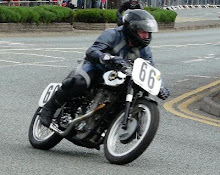
The development of my favourite the Gold Star.
When I came to work at BSA in 1952 there was no programme of development for the Gold Star, at that time we seemed to just pick up problems as they developed and try to fix them. The 350 Gold Star did quite well in the Clubmans TT, their power output averaged 27 to 28bhp. There were a number of problems causing retirements in the races the most serious of these was the heads burning near the joint face. Cyril Halliburn who was my assistant in those days suggested it was the porous castings and wanted to blame the foundry, strangely, the foundry did not deny this but said they did not understand what was wrong. In the Isle of Man during the practice period several of the heads were discovered to be 'burnt' when removed for examination. My opinion was that the joint at the Back to top of the cylinder barrel and head left an annular gap varying from .005" to .035", the wider joints trapped some gas which detonated causing the burnt heads. The normal gasket was a fairly thick copper asbestos affair, the production people claimed an inability to hold tolerances on cylinder barrel spigot and cylinder head spigot joint to less than .015", the gaskets also varied in thickness. It must be remembered that this gasket also had to make an oil tight joint at push rod tunnel. My solution was to use a ‘Plexseal’ joint, this gasket was formed of aluminium foil .002" thick stuck together to form a laminated gasket whose thickness could be varied by peeling off a layer one at a time to get a perfect joint, keeping the annular joint gap to between zero and .002" and yet still sealing the push rod tunnel. My suggestion was accepted but it did not reach production until later in 1952 or early 1953.
Another quite serious problem was the crankcase breather, situated in the timing case. A small pen steel disc acted as an automatic flap valve, unfortunately it did not work efficiently if at all at high speeds, thus allowing a lot of engine oil to blow out of the crankcase. Some of the riders ran out of oil due to this, all complained of the oil all over the rear tyre. My solution was to build a rotating sleeve in the timing cover driven by a peg on the magneto pinion, this was made in time for our testing at Montlhery in 1953. This mechanical breather was very successful as it kept the pressure in the crankcase about 4" - 7" below atmosphere at all speeds, which kept the oil in the engine and rear tire cleaner. Surprisingly this breather contributed a slight increase in power of 4bhp over the flap valve. The best timing was for the port to open 20 degrees before BDC on each stroke. Another problem was the occasional exhaust valve breakage which usually did quite a bit of damage.
The Research dept came up with the answer here. A special nickel alloy Nimonic 80, after its use I never saw another one break. A difficult problem was valve springs. I would have liked to have gone to hairpin springs but this was not possible. We tried all the usual approaches, talking to Terry's, the spring experts, even our friends at Rover designed a spring to try, our own spring shop tried various tricks and materials but we were getting very little progress, then Hap Alzina sent some S&W springs for the twins, I decided to try these in a Gold Star and they worked beautifully right from the start, giving us a big increase in maximum revs. I suspected shorter connecting rods might show some advantages in several ways, firstly by changing piston motion relative to crankshaft rotation, also shortening the whole engine including the push rods.. We built some 350 engines using A10 and A7 connecting rods, these showed an appreciable increase in performance but we could not be sure what was due to the shorter connecting roads or the fact that they were lighter and had plain bearing big ends. Mr Hopwood agreed to have some special forgings made up using the shorter dimensions, this enabled us to carry out some direct comparisons which showed that we had got a small increase in power through the lighter alloy rods and plain bearing, but that a worth while increase came from the shorter length rod.
These tests became useful later on when we wanted to find out whether a one-piece crankshaft offered any advantages over the built- up flywheel assembly. It showed excellent results especially at high revs, the only problem experienced with one-piece crankshaft was the connecting rod detachable bearing cap. It is very difficult to make a connecting rod with a detachable cap as strong as the one-piece rod. These 1952 Gold Stars had push rods made of solid dural with steel caps rivetted on. We substituted some 3/8 dia T4 tubing with lighter end caps pressed on. You can imagine how much lighter these were. I made, a sketch of a rocker spindle which had the rocker bearing portion machined eccentrically and the Drawing office made an official drawing and we were able to eliminate the heavy valve adjuster that kept the oil in the engine and rear tyre cleaner. Surprisingly this breather contributed a slight increase in power .4bhp over the flap valve. The best timing was for the port to open 20 degrees before BDC on each stroke. Another problem was the occasional exhaust valve breakage which usually did quite a bit of damage
The lower half of the Gold Star engine was basically similar to the 1938 M24 Gold Star and to the B33 post-war iron 500, although the crankpin assembly was changed quite a lot, the flywheels were always forged steel. The pre-war and the immediate post-war ZB Gold. Star differed quite a lot, including having bore and stroke changes. I liked the non-detachable rocker box of the ZB, even though it was a bit of a fiddle getting the head off with the engine in the frame. This earlier design avoided the oil leaks that later Gold Stars sometimes experienced at the rocker box joints. The later big fin Gold Star engine which I suppose is the version most beloved by enthusiasts, came about in the following way. After all the debacles we had been having with the twins some of which I have described, it was decided that as we were making a new cylinder head for the 350 Gold Star, we could afford a 500 version of it. Brian Jones of the Drawing office, a very capable and gifted young fellow, set about designing the new head. Mr Hopwood told him to consult with me on it so every day I would confer with him his office, look over his shoulder and make a few suggestions. He was decent enough to incorporate some of them.
One of my ideas was that of sloping the fins between the two rocker box joints to get an air flow across the dead space on Back to top of the head. Of course we did not know what the air would do but it worked well in practice. I am always a little skeptical about the air flow paths around a motor cycle cylinder head particularly when mounted in the frame. The new big fin heads both 350 and 500 had a cooling fin area of about 520 square inches. We measured it by getting an apprentice to cut out pieces of squared paper to match all the fins then laboriously compute their combined areas. We were.of the opinion that 520 square inches should be just adequate for the 500 version and possibly over generous for the 350. I do not think that at that time we visualised using one of these heads on a 250. Some interim heads for 1954 Daytona models were made by using 350 castings machined to suit 500, these gave more power than the normal 500 heads due to better down draft inlet ports and slightly more fin area. Of course they were a bit thin in places and tended to crack. The new heads were ready for the 1954 TT and were an instant success, and by using larger inlet valves the 350 power was increased from about 30 to 33-34bhp'.
The timed breather was also used and the eccentric rocker spindle and Nimonic 80 exhaust valves. The improved valve springs and the laminated head gaskets all contributed to a most reliable engine. The 500cc version gave over 44bhp in IOM trim. These engines all had the shorter connecting rods, the 500 had oval flywheels to get piston skirt clearance and still have some flywheel effect this later however proved to be unnecessary. During all this activity on Gold Stars many other developments were going on. We tended to let the mechanics specialize as they seemed to be more efficient in this way. Reg Wilkes for example did most Gold Star development, Arthur Butler worked on A7 and A10 development. Arthur Bridgewood worked on the 500cc overhead cam twins and the MC4. Bill Bently exclusive on MC1. Bert Hole worked on the twins . Alan Sandilands did some work on the MC1 and a lot of special projects like a scrambler C12, special short stroke engines with one piece crankshafts. Jimmy Gibbard spent his time as a machinist making special parts for the shop. Jake Turner came in later as both machinist and mechanic and did a lot of work on 250 Gold Stars, was also responsible for machining the straight port head for 350 Gold Star. All of them at some time or another worked on the 'experiments to find optimum bore and stroke dimensions. We did some experimenting with chrome plated cylinders which was promising but inconclusive.
Due to the temporary shortage of aluminium because of; the Korean War some Gold Star cylinders were, cast iron, we were instructed to evaluate these in case the factory was forced to use them. They were terribly heavy, about three times the weight of the standard alloy cylinder. Much to everyone’s amazement we got slightly more power and no overheating, the piston rings also appeared to run better in the iron cylinder, which set me thinking. When the original tests were completed we knocked all the fins off the iron cylinder and turned it down to a heavy sleeve in the lathe,, then bored a standard Gold Star cylinder jacket to be just a bit smaller than the outside of the iron sleeve. The alloy jacket was, heated up and dropped on, making a nice tight fit, a flange had been left at the bottom of the line to sit on crankcase face. As the line's had been left about *" thick, the Back to top of it made a good seat for the cylinder head. Due to all the machining and shrinking process the bore had distorted slightly and the rings did not bed in very well, so we had it lightly ground true which left it about .002" oversize.
On test it performed very well, more power, better oil control and no scuff marks as we got with the standard austenitic liners. I discussed this with 'Brico' the piston ring people and they said they were not surprised and agreed to make us two special thick sleeves for further testing, one using the austenitic material and one plain cast iron. We gave these extensive testing, the rings bedded better and controlled oil consumption better with an iron sleeve. The tests were repeated with 350 Gold Star, again the plain cast iron showed up to advantage.
The Design office were interested but reluctant to admit that austenitic was not necessary. They changed to the thicker liner in production, but I am not sure whether they changed the material. Early in 1953 we tested some chrome plated Back to top compression rings from Brico in a special 350 Gold Star we had built for Charlie Salt. This engine had what was then the new eccentric rockers, a plain big end bearing in an alloy con rod. This engine was in the 350 Gold Star we had taken to Montlhery for high speed testing. It performed very well but the chrome ring even after hours of running never really bedded in. We reported this to Brico and they said not to worry as they were grinding these rings with a slight taper degree on the face, and that we should find them ok. After trying these new taper face rings we found them very much better and ultimately got almost 34bhp from this engine. Unfortunately the connecting rod cap broke up in the Junior TT due to the self locking nuts coming loose.
Following a hot tip I had received, we built a 350 Gold Star with cylinder axis offset 3/8" to the rear, this gives a peculiar motion to the piston, with the effect of a short connecting rod 4 3/4" long and 8" long going down and 1.4 increase in bhp, but it was a rough engine. Due to the good results I had had using a dural (RR56) connecting rod with plain connecting rod bearing in my Rudges I wanted to try this in a Gold Star. We had made a connecting rod of this type, made to my drawings, it turned out to be reliable and smooth but very little more power than the standard steel rod. We used this engine for comparison tests of various parts and ideas for several years. It was finally sold for scrap when I left BSA Quite a bit of testing was of moulded bakelite big end bearing cages, as they would have been a lot cheaper to produce than the dural cages used in production, but they failed at high RPM.
The original Gold Star BSA got its name by lapping Brooklands race track at over 100mph in 1938 ridden by Wal Handley, a very fine rider. This was followed in 1939 by an alloy engine version called a Gold Star, it had 82 x 94 bore and stroke. In 1954 we made a modern version of this engine to see if the longer stroke showed any advantages, using M20 flywheels, a pre war piston and modern cylinder sleeved down to 82 mm. It was a disappointment as it did not pull any better and gave 42bhp. Charlie Salt & I rode it around Oulton Park. It was also tested as a scrambler by Dennis Hardwick and someone in the Competition department. After a final strip down and rebuild we got 4bhp which wasn’t bad but at the time the standard 500 Gold Star was giving 45-46 quite readily and as much as 50bhp as flash readings. We made a range of 350 engines with bore and stroke ratios varying from 63 x 112 to 71 x 88 and 76 x 76, 8.x 66 and 85 x 61.5.
Not all at once but fitted in with other testing, the 82 x 66 engine was built in two forms both used one piece crankshaft plain big end bearings and outside flywheels. The first engine had a higher compression ratio and orthodox intake port merely straightened and given a little more downdraft. The best reading on this engine was 38~bhp, but one day it seized up so suddenly that the flywheel inertia twisted the crankshaft making it impossible to strip. The next version had bigger diameter mainshaft and lower compression ratio, due to unavailability of the pre-war Gold Star piston we had been using, this engine was very reliable and we did all sorts of tests using various carburettors, silencers and cams.
The best power with racing set up was 36bhp at 7250 RPM and 36.1 at 7750 RPM. The most interesting was the power obtained with road cams and silencer and monobloc carburettor 27.3 at 7000 and still pulled strongly at 2500 RPM. From these test in 1953-54-55 I became convinced that short strokes were the way to go. Modern 1988 motor cycles would seem to bear this out. The Gold Star head gasket joint system is rather unique and merits some comment, the push rod tunnel construction called for something other than the classic four stud joint to prevent oil leaks. The system adopted consisted of four long studs coming up from the crankcase in orthodox fashion, plus four more short bolts that simply united barrel and head from below, one bolt in the push rod tunnel the others at front and rear and on the left side. All eight bolts screwed into bronze inserts which are themselves screwed into the head casting. The system was not completely successful as we sometimes got leaky joints. Another snag was the difficulty in tightening the rear bolt, sometimes it was necessary to remove the magneto in order to get at this bolt, so we often left them out with no ill effects. At one time we went to only five fixtures, with no problems. on our special engines we adopted the final variation on these themes by making four hollow steel tubes to replace the crankcase studs and ran four bolts down from the head into the internal threads in the four tubes, which had external threads at their lower ends where this four bolt arrangement was fully proof against gasket blowing and greatly simplified head removal, especially with the engine in the frame. This last system would have been cheaper, but in spite of this was not adopted.
Connecting rod breakage used to be a frequent Back to topic of conversation amongst racing men as breaking at high speed can lead to some terrifying moments, besides doing a lot of damage. I believe the forged steel rods in BSA engines were outstandingly good. A number of Manx Norton riders I know used them because they found them more reliable than some of their original equipment. BSA had a great deal of know-how when it came to forging. No one else in the motor cycle industry forged their own connecting rods, other makes had to go to outside supplies like Laystall or Garrington. Naturally when you make parts yourself you have more control and you can try different components. We were lucky in that we had a good smithy and good people working in it.
About the time Lucas came out with a new racing magneto of the rotating magnet type, it was supposed to be less affected by vibration and more reliable but I was not very, impressed with its performance, it also had less range of advance, and retard. Personally I preferred the BTH magneto. We borrowed a 350 Manx Norton engine in 1956 which had a good power curve, we got 38bhp and very good torque with it, rather better than our own engines. On examining the cams we found that due to being a double overhead camshaft design there was very low reciprocating weight, enabling very quick lifts to be used without very 'long' timing. This particular Norton was a square engine 76 x 76 with squish piston. We built a Gold Star engine to these dimensions to test the so called squish effect using a Norton piston in a modified BSA head, this gave us 36.4bhp but we could get practically the same power with ordinary non-squish combustion chamber, maybe it only works with higher compression ratios, ours was 9.0: 1
The quality of mechanics who were employed in development was very high, there was not much they could not do. Alan Sandilands once made some prototype cams by hand. Jake Turner was a terrific machinist, very fast and accurate, he also thought up the method of making a virtually straight inlet port. Reg Wilkes was the artist who would fettle a piston and head until he got the maximum power that was possible.
We made some alloy tappets that were very light and worked very well, they seemed to be very compatible with the hard steel cams, the only problem was after about 500 racing miles they broke, but while they worked they were good. I feel sure that if we had been able to make larger diameter guides and stems to suit they would have been very satisfactory. Charlie Salt once set out to design a new crankcase for the Gold Star using a high camshaft, but it had to look like a BSA he was told. Sunbeam and Rudge had both made high camshaft engines pre-war with chain driven camshafts.
At various times we had problems with A10 and A7 connecting rods especially when used in the plain bearing Gold Star. We were trying to get away from split pins and castellated nuts and trying various patent self-locking nuts. The only one that was successful was the pinnacle nut which had a steel diaphragm to lock the nut. One of my ambitions was to utilise all the successful ideas we had used on the Gold Star and make them standard parts so that the B31 and B33 would use .the same connecting rods and valve sizes, push rods made of tubular alloy instead of solid, eccentric rocker spindles and the simple Gold Star rocker, but still retaining the iron heads and cylinder barrels. Unfortunately the production people could not see the benefit of these ideas. We did extensive testing with floating bush big end bearings mostly in the 500 Gold Star on the basis that if it stood full power and revs in that, it would certainly last in a lower power engine. The floating bushes were very much cheaper to make. During road testing at MIRA. Barry Stormont did 116 miles in the hour which was something of a record for us. It was in winter time and he was literally frozen stiff, we had to take him out to a warm cafe to thaw him out.
All through a long test programme, using factory bushes made by Glacier bearings we had no trouble, but when we started using their production samples they were almost useless, so we had to F->rop the whole scheme, which was a pity. We also tried a large diameter wrapped bush running on a large crankpin, we tried both bi-metal and copper lead, they were both satisfactory, but the larger crankpin was so rigid we had trouble aligning the flywheels. All these plain bearings really need a large paper filter built in to the engine, but all we had was a small tecalemit filter on the return oil line. Although either of these bearings would have shown a big economy I did not receive much encouragement. I think the factory was scared to make a change, although they already had these plain bearings in the twins during testing of the floating bush connecting rod bearing we had problems with over oiling. It appeared that too much' oil was being thrown up to the cylinder and piston, this we corrected by reducing the diameter of the flywheels and chamfering them.
The following summary of the development of the Gold Stars may be of interest.
1952 350cc
27 - 28bhp
1956 350cc
35 - 36bhp
1952 500cc
35 - 37bhp
1956 500cc
44 - 46bhp
We felt that these increases came from higher revs which in turn came from lighter valve gear, better springs, larger carburettors, higher compression with cooler running due to the big fin heads plus higher octane fuel. About 1955 the desire developed for a better brake for our scramblers. Since the management wanted to avoid spending money, as usual it was decided one brake would have to do for both Clubmans TT and racing Gold Stars-and Scramblers. Dennis Hardwick wanted a small intake for the scramblers, Charlie Salt and I wanted a big brake for the Clubman. We compromised on a 19O mm brake on Charlie’s suggestion, who told me he was banking on a belief that Hardwick would not know how big 190mm really was. As it turned out Hardwick didn’t. So we came out with this fairly large brake, with wide shoes which was used for some years afterwards although in my opinion it was not as good as the earlier cast iron drum with ribs around it. That was the best Gold Star brake. Charlie did not like it himself and he blamed Hardwick for the fact that it was too small as he would have preferred 200mm diameter. The l90 mm brake was designed by Charlie and it turned out to be rather heavy for its size.
Showing posts with label Charlie Salt. Show all posts
Showing posts with label Charlie Salt. Show all posts
Sunday, 25 January 2009


Roland Pike Autobiography - Chapter 20
Tales of the Bantam C12, C15 & MC4
The BSA Bantam and the Harley Davidson Hummer were snatched from the Germans as 'reparations' after World War II. The Bantam started as a DKW in 1935 or 36 when it was considered modern with its flat Back to top piston, but by 1946 when BSA got it, it was already old fashioned. One could get about 4.5bhp from the 125cc if you were lucky, more often only about 3.5. The noise they made was dreadful and so was the oil they blew all over the test shop. We worked on them for a couple of years, making all sorts of experimental bits and pieces, none of which worked very well. I recall someone wanted to ride one in the International Six Days Trial and Bert Perrigo the BSA Competition manager persuaded us to build him a 'special'.
Reg Wilkes worked on it for a couple of weeks and got 5 or 6bhp over a wider range than the standard machine. Another time an Australian sent us under great secrecy his Bantam which was reputed to be very powerful and high revving and all the rest. It was highly modified and ran on alcohol blended fuel, they claimed 12bhp and had been timed to exceed 90mph We were suitably impressed and set it up on our dyno, we mixed the prescribed blend of fuel of alcohol benzole and acetone and ran it. However we could not stop it from four stroking and it would not give more than 6bhp. We were reluctant to jet it down in case we burned it up. So we gave up, deciding that the cold damp November air did not suit it, it apparently needed hot dry Aussie air.
In the development shop at BSA we used to hate the sound and sight of the Bantam. When I first went there we were responsible for Bantam development, but I disliked two strokes then and I still do. I suggested to Hopwood why didn’t he get Herman Meier who had been with on the Continental Circus trip in 1951 who was an enthusiast as I felt sure he would make them run. Finally after a lot of trouble with work permits and so on we got Herman over and he shared an office with me. He doubled the power of the Bantam in a few months. Unfortunately Herman was a temperamental type and I eventually recommended that he be moved to Redditch where the Bantams were made anyway. Here he got some good power outputs from the 125cc Bantam and developed the larger versions they eventually produced.
Occasionally a 250 C12 came into the shop, this was a simple and cheap engine, designed in 1935 as a light and inexpensive utility machine based on a Blackburn design used by Excelsior and Frances Barnett a year or earlier. It was novel in that the push rods crossed in the tunnel at the same angle as the valves.
One day the C12 production line was stopped due to repeated complaints from the Dealers of 'knock' from the engine. Mr Leake called a meeting of everyone concerned and told us to cure it or it would have to be dropped from production. A big panic ensued, several engines that were 'knockers' were brought into my shop and we found the in some cases the knock could be cured by retarding the ignition very slightly, but some of the worst examples 'knocked' regardless of timing etc. These were stripped right down for thorough examination, we noticed that the flywheels were made of cast iron whereas when the engine was first produced it had flywheels of steel stampings. We were able to get some of these and when fitted to the worst offenders it completely cured the problem. Whilst fiddling with C12 250cc we tried the alloy cylinder head from the Ariel Colt, a 200cc version of the same engine, this cylinder head cured 'knocking' and gave more power, which prompted us to make a 'deluxe' C12 which after a few quite simple modifications gave 15bhp. An engine was passed to the experimental dept for road testing, but I do not remember any conclusions being made and soon after the 015 was designed. This was another 'cheap' design based on the Triumph Terrier 150cc. In my opinion a poor thing.
The MC4 design which was very promising was essentially half an A7 twin, the better half I thought as it was more reliable than the A7. It was intended to make a 350cc version using A10 parts. This would have been helpful to the production people as so many parts would have been interchangeable. The camshaft had to be different of course for a single cylinder. The original design used a one-piece iron casting unfortunately the cast iron was not up to the job and the first one broke, possibly 'Nodular' iron would have done the trick or the larger crankpin as used later in A7 & A10 would have helped. At about this time (1952) we used our first alternators built into the engine timing case, this gave it an odd shaped bulge, they worked very well and used less horsepower than the regular generator with rotating armature. I think if it had gone into production some resistance would have been encountered from the typical motor cyclist over the odd appearance of this engine, but once they realised the advantages of the engine they would soon forget the appearance.
The MC4 gave half the power of the racing A7 but with much greater reliability. This could only be explained by the fact that the main bearings were only some three inches apart giving an inherently more rigid lower end than the A7, which suffered from crankshaft whip. One of the things we learned a lot about during the MC4 development was mechanical berathers. As designed it had a disc valve breather as on the earlier Gold Star, at high revolutions the little pen steel disc valve could not cope and as a result blew oil out in large amounts. The same problem on the early Gold Star caused several retirements in the Clubmans TT races due to loss of oil and too much oil on the rear tire became very mechanical breather conscious and tried to adapt the A7 mechanical breather to the MC4. At first it would not work satisfactorily finally we fitted copper pipe inside the crankcase, picking up breather air from a 'dry' spot in the corner of the crankcase. This was much more effective in terms of oil loss, but the crankcase pressure was disappointing until we retarded the timing of the breather valve by 70 degrees, it would then maintain a pressure inside the crankcase of between of 4 and 7 inches of water lower than atmospheric at all speeds. This kept the engine very clean, even when belting round MonthIery track at nearly 100mph.
Due to the MIRA test track not being completed we arranged to go to France and use the banked track at Monthlery for a week. We.loaded the MC4, a 350 Gold Star and two 650 A10 Police Specials into our van, which was my old race van which I had bought from Ray Amm in 1952, now fitted' with a V8 engine. Charlie Salt and I were the hobbledeboys, we drove the van via Dover and Boulogne to Paris. Arthur Lupton and Bert Hopwood drove an A40 Austin. Bill Nichols flew out to join us a little later. Strangely enough although Bill was such a dare-devil in Scrambles and on the road, he was completely over-awed by the banked track. He was unable to lap as fast as I did and I was putting on weight and my leathers were tight. Charlie being neat and slim lapped about 3mph faster than I did and I was a little faster than Bill. The demonstration of the police bikes to the National Guard was the funniest thing. The police were all Triumph enthusiasts and did not like BSAs. When our bikes lapped faster than the Police Triumphs they removed the silencers, saying "now we will go faster". We wondered whether we should remove our silencers as well and go faster still, but it was getting ridiculous. Their police model Triumph had the infamous sprung hub and at speed on the banking looked positively dangerous. It started to drizzle with rain and I thought now we will show them, our bikes had the old plunger springing, it seemed steadier than the Triumph on the banking. However they would not ride on the track in the wet. I did a couple of fast laps in the wet at about 103mph and was skating about all over the place. So we adjourned for lunch with the Distributor and his guests from the Guard Nationale. We spent the rest of our time there testing the MC4 and found the heavy front mudguards were holding our speed down to 93mph, so we removed front mudguard and tipped the headlamp to try and improve the streamlining - we could not remove jt because it contained switchgear etc. The bike was road equipped except for a megaphone in place of the silencer. This put the speed up to 96 for the lap. When timed the Gold Star and Charlie slipstreamed me on the MC4 we lapped at just on 99mph. When we switched bikes we could lap at 97. For a 250cc push rod machine which was not designed as a racer these times were very good, the engine was putting out about 24.5bhp. The racing Excelsior 250 claimed 22.5bhp on 50/50 petrol benzole. We were using pump fuel of 78 octane. However when we returned to the factory the Board of Directors decided against producing the MC4 which was a great disappointment to all of us, we who had seen its promise. A version was assembled with sheet metal covering over crankcase and gearbox, a different colour scheme and Sunbeam name on the tank, this was also turned, down. The C12 and its variations stayed in production.
Subscribe to:
Posts (Atom)