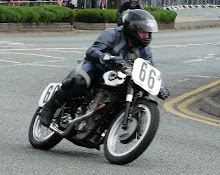
Last month I wrote about the project to restore and parade the 1954 Daytona winning BSAs at Daytona speed week in 2004 as part of a 50 th anniversary event. Daytona 2003 has just finished and we now have one year to prepare the bikes and organise the event itself. Let me tell you a bit more about both.
The Bikes The Daytona 200 was the most important race US calendar - equivalent to the TT. At that time the race was run on a large oval circuit that had one straight on sand, one on tarmac. In 1954 BSA sent both Gold Stars and Shooting Stars to Daytona. Both were fitted with rigid frames as it was felt that the reduced weight was of greater benefit on sand than swinging-arm suspension. We are restoring examples of both machines for 2004 - Tommy McDermotts Gold Star and Al Gunters Shooting Star.
Although US regulations of the time required these to be production bikes in a future update Ill tell you about some of the very non-production (!) details we found while working on these and the difficulty we’’ve had researching them before restoration work started.
The Event Our event is intended to celebrate BSAs win in 1954, the original riders and BSA in general. It is actually a series of activities that will be held within the larger Daytona speed week, a motorcycling party that eclipses the TT in both scale and scope. Our smaller ‘party will consist of::-
Friday, Saturday & Sunday - Antique Motorcycle Club of America Concours event spotlight on BSA at Eustis
Monday and Tuesday – Parade lap with restored bikes and riders at Daytona Speedway
Thursday – Concours display and ride-out to Jerry Woods action and swap meet at Deland
Thursday evening – Banquet and ‘meet the riders event at Stetson University.
The project team, the surviving riders and other BSA luminaries such as Jeff Smith, John Gardner and Dick Mann will attend the banquet to talk about the race and answer questions. Others have been approached and are still to be confirmed – watch this space
Monday, 21 March 2011


Project Daytona, February 2003
This was originally posted as a blog style entry on a website, documenting the progress of Project Daytona through research and restoration of two BSA Daytona racers in 2004 as part of the 50th anniversary celebrations of BSA's historic win in 1954.
In March 1954 BSA won the 200 mile expert race at Daytona Beach, Florida. Bobby Hill won on a Shooting Star, heading a field of 107 riders to complete the 200 mile race in 2 hours, 7 minutes and 22.70 seconds at an average speed of 94.24mph.
The next 4 places were also BSAs, with the nearest American bike being Don Hutchinson's Harley in 10th place.This was the most important event in the US racing calendar, comparable with the TT.
Although this was one of BSA's greatest sporting achievements the event passed largely uncelebrated at the time and has been barely mentioned in books and magazines since.In March 2004 a multinational group of BSA restorers hope to rectify this injustice by celebrating the 50th anniversary of the win at Daytona 2004. Restored bikes - a Gold Star and Shooting Star - will be paraded by the original BSA riders, Bobby Hill, Kenny Eggers, Dick Klamfoth, Gene Thiessen and Tommy McDermott.
The event will be supported by the American Historic Racing Motorcycle Association, will be attended by various luminaries in the classic bike scene and the intention is to make this a big event with lots of press! While I'm sure this news will interest the BSA nuts, club members might also be interested to know that the Scottish member of the restoration team is club member Myles Raymond.
Myles and his buddies in the US have been working on this project for the last 2 years on an epic journey that has at times been more like archaeology than restoration but is now.Myles will be posting progress reports in the newsletter as the project moves into the last 12 months before the big event in March 2004
In March 1954 BSA won the 200 mile expert race at Daytona Beach, Florida. Bobby Hill won on a Shooting Star, heading a field of 107 riders to complete the 200 mile race in 2 hours, 7 minutes and 22.70 seconds at an average speed of 94.24mph.
The next 4 places were also BSAs, with the nearest American bike being Don Hutchinson's Harley in 10th place.This was the most important event in the US racing calendar, comparable with the TT.
Although this was one of BSA's greatest sporting achievements the event passed largely uncelebrated at the time and has been barely mentioned in books and magazines since.In March 2004 a multinational group of BSA restorers hope to rectify this injustice by celebrating the 50th anniversary of the win at Daytona 2004. Restored bikes - a Gold Star and Shooting Star - will be paraded by the original BSA riders, Bobby Hill, Kenny Eggers, Dick Klamfoth, Gene Thiessen and Tommy McDermott.
The event will be supported by the American Historic Racing Motorcycle Association, will be attended by various luminaries in the classic bike scene and the intention is to make this a big event with lots of press! While I'm sure this news will interest the BSA nuts, club members might also be interested to know that the Scottish member of the restoration team is club member Myles Raymond.
Myles and his buddies in the US have been working on this project for the last 2 years on an epic journey that has at times been more like archaeology than restoration but is now.Myles will be posting progress reports in the newsletter as the project moves into the last 12 months before the big event in March 2004
Project Daytona, February 2003 – In The Beginning
This was originally posted as a blog style entry on a website, documenting the progress of Project Daytona through research and restoration of two BSA Daytona racers in 2004 as part of the 50th anniversary celebrations of BSA's historic win in 1954.
Why are some people who have never met and who live in different continents restoring bikes via the internet?
The story starts in the 1990s when some BSA enthusiasts in Florida wonder if it would be possible to find and restore a Daytona BSA, a bike that has always fascinated them. But there are two problems - they can't find a bike and can't find anyone who knows anything about them.
Although they don't know it at the time, another BSA enthusiast in Scotland is researching twin carburettor kits sold for BSA pre-unit twins in the USA. His research also touches on the Daytona twins, as these were fitted with twin carburettors. He puts the result of his research on a web site. One of the Florida guys, Don Bradley sees the reference to Daytona bikes on the site and emails the Scottish BSA guy Myles Raymond asking for any information he has about these bikes. Myles doesn't have much so asks what Don has. Neither has much but both agree that this is important information and that they should keep in touch and share whatever they find.
A year later they get in touch again - things have moved on. Don has unearthed more parts, more information and has decided to restore the bikes in time for the 50th anniversary of BSA's 1954 in 2004. He wants this to be a big event and plans a celebration attended by the original BSA riders. By this time Myles has more information too, has some leads on UK contacts who may know even more about the bikes' history and is planning to create an online archive for the information.
Things have now reached a critical mass. Myles offers to help the project any way he can but thinks that because he is in the UK, he is best placed to find information or ex- BSA staff who might help. Don will head-up the restoration partly because he has the bits of bike that have been found so far and partly because Myles is by his own admission is a poorer mechanic than Don.
They decide that the only practical way to share this information is to keep it all on a website where it will be available to anyone regardless of location or timezone. Myles will build the website partly because he's done one already and partly because Don is by his own admission, a poor typist.
So a website is built and used as an online archive and project management tool. Early in the research stage while the team is still uncertain about the specification of the bikes the web site contains much information that is speculative. To protect against the more militant BSA enthusiasts who might interpret the web site contents as gospel and take issue a decision is made to keep the site private. The URL is only circulated among the project team members or trusted individuals who are helping.
In practice the website works spectacularly well, bridging the difference in distance and time and the restoration proceeds.
There are still problems to solve and questions to answer but by April 2003 the team is confident enough that they can complete the bikes to the original specification and the website finally goes public in April 2003.
Why are some people who have never met and who live in different continents restoring bikes via the internet?
The story starts in the 1990s when some BSA enthusiasts in Florida wonder if it would be possible to find and restore a Daytona BSA, a bike that has always fascinated them. But there are two problems - they can't find a bike and can't find anyone who knows anything about them.
Although they don't know it at the time, another BSA enthusiast in Scotland is researching twin carburettor kits sold for BSA pre-unit twins in the USA. His research also touches on the Daytona twins, as these were fitted with twin carburettors. He puts the result of his research on a web site. One of the Florida guys, Don Bradley sees the reference to Daytona bikes on the site and emails the Scottish BSA guy Myles Raymond asking for any information he has about these bikes. Myles doesn't have much so asks what Don has. Neither has much but both agree that this is important information and that they should keep in touch and share whatever they find.
 |
Myles Raymond - research and website, Scotland |
Things have now reached a critical mass. Myles offers to help the project any way he can but thinks that because he is in the UK, he is best placed to find information or ex- BSA staff who might help. Don will head-up the restoration partly because he has the bits of bike that have been found so far and partly because Myles is by his own admission is a poorer mechanic than Don.
They decide that the only practical way to share this information is to keep it all on a website where it will be available to anyone regardless of location or timezone. Myles will build the website partly because he's done one already and partly because Don is by his own admission, a poor typist.
 |
| Don Bradley, Bob Birdsall - BikeRestorations, Florida |
So a website is built and used as an online archive and project management tool. Early in the research stage while the team is still uncertain about the specification of the bikes the web site contains much information that is speculative. To protect against the more militant BSA enthusiasts who might interpret the web site contents as gospel and take issue a decision is made to keep the site private. The URL is only circulated among the project team members or trusted individuals who are helping.
In practice the website works spectacularly well, bridging the difference in distance and time and the restoration proceeds.
There are still problems to solve and questions to answer but by April 2003 the team is confident enough that they can complete the bikes to the original specification and the website finally goes public in April 2003.
Subscribe to:
Posts (Atom)